

Sorting through personal finance books for students is trickier than it sounds, because the category mixes teen-friendly starter guides, dense college textbooks, and adult money manuals repackaged for younger readers. After comparing 15 of the most popular options, I named Get a Financial Life by Beth Kobliner my best overall pick — it covers the exact decisions students face right after graduation, from student loan repayment to first-job benefits, in plain language. The Infographic Guide to Personal Finance is the standout for visual learners and tight budgets, while Personal Finance 101 suits absolute beginners who want one slim volume. The main tradeoff you’ll face is depth versus readability: textbooks like Glencoe’s offer classroom-grade thoroughness but cost several times more and assume an instructor. Keep reading for the full breakdown of all 15 books, who each one suits, and who should skip it.

Get smart everyday buys delivered free with Prime
- Fast, free delivery on millions of items
- Prime Video, Amazon Music and more included
- Member-only deals all year
Key Takeaways
- Get a Financial Life earned the top spot because it targets the money decisions students actually face next — loan repayment, renting, first salaries — instead of generic saving advice.
- Price and usefulness barely overlap in this category: several $15–$20 paperbacks outperformed $80+ textbooks for self-directed readers.
- The teen-focused titles look interchangeable but split sharply on tone — the better ones, like 101 Money Secrets, talk to teens like adults, while weaker options read like lectures.
- The Infographic Guide to Personal Finance was the only book in the lineup a reluctant reader could realistically finish in a weekend, which matters more than page count.
- Niche picks beat generalists for specific students: The White Coat Investor is a smarter buy for a future doctor than any all-purpose guide on this list.




| personal finance books for student | Format | Audience | Language | Core topics |
|---|---|---|---|---|
| Get a Financial Life: Personal | Paperback (print) | Adults in their twenties and thirties | English | Budgeting, saving, investing, and debt management |
| The Student’s Pocket Guide to | Paperback (print) | Students new to money management | English | Budgeting, saving, and managing money |
| Personal Finance For Dummies | Paperback (print) | General adult beginners | English | Budgeting, saving, investing, and planning for the future |
| The White Coat Investor: A Doc | Paperback (print) | Doctors and other medical professionals | English | Investing, student loans, insurance, and financial independence |
| Glencoe Personal Finance | Hardcover textbook, Student Edition | High school and college students | English | Personal finance fundamentals and recordkeeping |
| Business and Personal Finance | Hardcover, Student Edition | High school students | English | — |
| The Infographic Guide to Perso | Paperback | — | English | — |
| Personal Finance | Hardcover, Student Edition | High school and early college students | English | — |
| How to Adult: Personal Finance | Kindle and paperback | New graduates and young adults | English | — |
| The Complete Guide to Personal | Paperback | Teenagers and college students | English | — |
| Personal Finance 101: From Sav | Hardcover | Beginners of any age, including students | — | Saving, investing, taxes, loans, retirement |
| Personal Finance for Teens and | Paperback | Teens and young adults | — | Budgeting, saving, investing |
| The Beginner’s Guide to Person | Kindle eBook | Teens and college-bound students | — | Budgeting, banking basics, first bills |
| Personal Finance for Teens and | Kindle eBook | Teens and college students | — | Everyday money management |
| Personal Finance for Teens and | Kindle eBook | Teens and young adults | — | Budgeting, saving, investing |
More Details on Our Top Picks
Get a Financial Life: Personal Finance in Your Twenties and Thirties
Of the books in this roundup, Get a Financial Life is the one I’d hand to a student who wants a single volume that grows with them. Beth Kobliner’s advice runs from first-apartment budgeting through 401(k) decisions and insurance, so it stays useful well past graduation — something The Student’s Pocket Guide to Personal Finance, with its deliberately slim scope, can’t claim. Compared with Personal Finance For Dummies, it speaks more directly to twenty-something money situations rather than addressing a general adult audience. The tradeoff is depth on investing: readers wanting portfolio construction detail will hit the book’s ceiling quickly, and advanced topics get light treatment. The plain, jargon-free writing makes that an acceptable trade for most students building a financial foundation.
Pros:- Covers budgeting, saving, debt, insurance, and investing in one volume
- Aimed squarely at twenty- and thirty-something money situations
- Plain, jargon-free explanations that suit first-time readers
- Stays useful after graduation as finances grow more complex
Cons:- Investing coverage stops short of portfolio-level detail
- Light on advanced topics like tax strategy
- Less hand-holding than a true beginner primer
Best for: Students who want one book that stays relevant from campus life through their thirties
Not ideal for: Readers who want deep investing instruction — it stops at the intermediate level
- Format:Paperback (print)
- ISBN-10:1668095351
- Author:Beth Kobliner
- Language:English
- Audience:Adults in their twenties and thirties
- Core topics:Budgeting, saving, investing, and debt management
- Approach:Practical how-to guidance
- Reading level:Beginner to intermediate
Our verdict“If a student buys just one money book, this is the most well-rounded choice on the list.”
The Student’s Pocket Guide to Personal Finance
Where Get a Financial Life asks for a few evenings, The Student’s Pocket Guide to Personal Finance asks for an afternoon. Its compact format strips money basics — budgeting, saving, avoiding common debt traps — down to what a busy student can actually absorb between classes, which makes it the lowest-friction starting point here. Against Personal Finance For Dummies, it trades range for speed: there’s less on insurance, taxes, and investing, and no companion digital resources to extend the lessons. I’d treat it as a first read rather than a reference book. Students who finish it wanting more will likely graduate to one of the thicker guides on this list, but as a gentle on-ramp for someone who’s never budgeted, that brevity is the point, not a flaw.
Pros:- Short enough to finish in a single weekend
- Focuses on the core habits: budgeting, saving, and debt avoidance
- Low-commitment entry point for total newcomers
- Pocket-sized format is easy to keep on hand
Cons:- Thin coverage of investing, taxes, and insurance
- No companion digital tools or online resources
- Readers will outgrow it quickly
Best for: Busy students who have never budgeted and want the fastest possible start
Not ideal for: Students who want one lasting reference — its slim scope gets outgrown within a semester or two
- Format:Paperback (print)
- ISBN-10:1737223619
- Language:English
- Audience:Students new to money management
- Core topics:Budgeting, saving, and managing money
- Approach:Concise pocket reference
- Extras:No digital or online resources listed
Our verdict“The right first book for a student who won’t finish a 300-page guide.”
Personal Finance For Dummies
Personal Finance For Dummies earns its slot as the beginner anchor of this list. Eric Tyson’s framework assumes nothing — banking, credit, budgeting, insurance, and investing each get a full, orderly walkthrough — which makes it a safer first book than Get a Financial Life for readers who don’t yet know what they don’t know. It also covers more ground than The Student’s Pocket Guide to Personal Finance, so it doubles as a long-term reference you can return to when a real-life money question shows up. The downside is tone and targeting: it’s written for a general adult readership, so student-specific concerns like financial aid and campus jobs get little attention. Readers with any background will find the plain-language pace slow, and advanced strategy sits outside its remit.
Pros:- Assumes zero prior knowledge and builds up in order
- Wide coverage doubles as a long-term reference
- Clear, plain-language explanations throughout
- Strong on credit, insurance, and banking basics
Cons:- Written for general adults, so student-specific issues get little space
- Too slow-paced for readers with any finance background
- Skips advanced investing strategy
Best for: First-time readers who want every money topic explained from zero
Not ideal for: Anyone past the basics — the deliberate pace will frustrate experienced readers
- Format:Paperback (print)
- ISBN-10:1394207549
- Author:Eric Tyson
- Series:For Dummies
- Language:English
- Audience:General adult beginners
- Core topics:Budgeting, saving, investing, and planning for the future
- Reading level:Beginner
Our verdict“Best for the complete beginner who wants one thorough reference rather than a quick read.”
The White Coat Investor: A Doctor’s Guide to Personal Finance and Investing
This pick makes the most sense for exactly one reader: the medical or dental student staring down six figures of debt. The White Coat Investor addresses problems no general guide touches — residency finances, physician disability insurance, student loan strategy for MDs, and contracts — which is why it outranks broader books like Get a Financial Life for that audience despite its narrower appeal. Compared with Personal Finance For Dummies, it skips the banking basics and goes straight to high-earner investing and asset protection. That focus is also its weakness. A nursing or engineering undergrad would get more from almost any other book here, and readers early in their schooling may find the attending-level tax talk premature. Buy it for the specific career path, not for general literacy.
Pros:- Speaks directly to medical students’ debt and income trajectory
- Covers physician-specific insurance, contracts, and loan strategy
- Actionable investing guidance for future high earners
Cons:- Little value for students outside medicine
- Attending-level tax and asset-protection content is premature for early undergrads
- Skips foundational basics like banking and budgeting
Best for: Medical and dental students facing large student loans and a high-earning career ahead
Not ideal for: Non-medical students — nearly every example assumes an MD career path
- Format:Paperback (print)
- ISBN-10:0991433106
- Author:James M. Dahle, MD
- Language:English
- Audience:Doctors and other medical professionals
- Core topics:Investing, student loans, insurance, and financial independence
- Focus:Career-specific finance for high earners
Our verdict“The clear pick for med students; everyone else should choose a general guide from this list.”
Glencoe Personal Finance, Student Edition
Glencoe Personal Finance, Student Edition plays a different role than the trade books on this list: it’s a classroom textbook, complete with recordkeeping exercises and end-of-section activities. For homeschool families or self-paced learners who want structure — quizzes, worksheets, defined units — it does what Personal Finance For Dummies won’t, which is make you practice rather than just read. Set against The Student’s Pocket Guide to Personal Finance, it’s heavier in every sense: more pages, more rigor, more commitment. The tradeoffs are real, though. Textbook pricing runs well above the paperbacks here, the tone is institutional rather than conversational, and casual readers will bounce off the exercises. I’d recommend it only if structured coursework is what you’re after.
Pros:- Structured units with recordkeeping exercises that force practice
- Classroom-tested curriculum from an established education publisher
- Broad coverage of financial literacy fundamentals
- Works for homeschool or self-paced study
Cons:- Textbook pricing far above the trade paperbacks on this list
- Dry, institutional tone
- Overkill for readers who just want money basics
Best for: Homeschool families and self-paced learners who want assignments and structure
Not ideal for: Casual readers — the exercises and textbook pricing only pay off in a structured course
- Format:Hardcover textbook, Student Edition
- ISBN-10:0021386080
- Publisher:McGraw-Hill Education (Glencoe)
- Language:English
- Audience:High school and college students
- Core topics:Personal finance fundamentals and recordkeeping
- Includes:Recordkeeping exercises and activities
Our verdict“Choose it for structured coursework or homeschool use, not for casual reading.”
Business and Personal Finance, Student Edition (Personal Finance Recordkeeping)
Most books in this roundup teach you how to handle your own paycheck; Business and Personal Finance, Student Edition goes further by pairing personal money skills with the fundamentals of small-business finance and recordkeeping. For a student who wants to freelance, run a side hustle, or eventually open a business, that dual focus matters more than any single feature list. Compared with Personal Finance, Student Edition (0078958393) — a companion text from the same publisher that covers personal topics alone — this one trades some depth in consumer finance for broader entrepreneurial coverage. The tradeoff is real: it reads like a traditional classroom textbook, with chapter reviews and exercises rather than the conversational tone of How to Adult: Personal Finance for the Real World. I see it working best alongside a teacher or with a motivated self-studier; casual readers may find the workbook format slow going.
Pros:- Covers both personal and small-business finance in one text
- Recordkeeping exercises build hands-on bookkeeping habits
- Structured like a course, with chapter reviews and practice problems
- Strong fit for students planning a side hustle or startup
Cons:- Reads like assigned homework, not a book you’d pick up for fun
- Business coverage means less depth on pure consumer finance
- Sparse product data and no reader reviews make it hard to verify how current the material is
Best for: Students interested in entrepreneurship or side hustles who want bookkeeping skills taught alongside personal money basics
Not ideal for: Casual readers — the textbook exercises and dry prose demand a motivated, course-style reader
- Publisher:McGraw-Hill/Glencoe
- Authors:Jack Kapoor, Les Dlabay, Robert Hughes
- Format:Hardcover, Student Edition
- Publication year:2011
- Language:English
- ISBN-10:0078945801
- Audience:High school students
- Coverage:Personal finance, small-business finance, and recordkeeping
Our verdict“The right buy for a business-minded student willing to work through a textbook; everyone else should start with something lighter.”
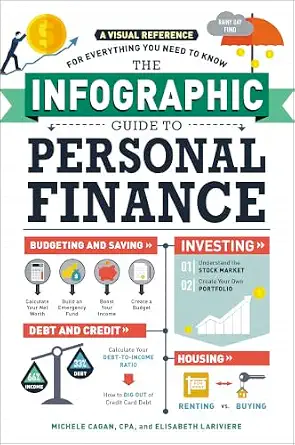
The Infographic Guide to Personal Finance: A Visual Reference for Everything You Need to Know
If dense textbook chapters are what turned a student off money books in the first place, The Infographic Guide to Personal Finance is the antidote. Michele Cagan distills budgeting, banking, credit, and investing into full-color charts and diagrams, so a concept like compound interest lands in one page instead of ten. Where Personal Finance, Student Edition builds skills through lengthy exercises, this book works as a fast visual reference you flip open when a term or decision comes up. The tradeoff: the format caps how far any topic can go, and readers who already know the basics will outgrow it quickly. It also skips the hands-on recordkeeping tools that Glencoe’s student editions include. I’d pair it with a more thorough text rather than rely on it alone — it explains the map, but it won’t walk the route with you.
Pros:- Charts and diagrams make abstract concepts like compound interest click fast
- Works as a quick reference you can revisit when a real money decision comes up
- Covers the full spread of beginner topics: budgeting, credit, banking, investing
- Low intimidation factor for readers who would never open a textbook
Cons:- Too shallow for anyone past the beginner stage
- No exercises or recordkeeping tools, so nothing turns reading into practice
Best for: Visual learners and reluctant readers who want core money concepts explained in minutes, not chapters
Not ideal for: Students who need structured practice or investing depth — the infographic format stays at the overview level
- Author:Michele Cagan
- Publisher:Adams Media
- Publication year:2017
- Format:Paperback
- Pages:128
- Language:English
- ISBN-10:1507204663
- Coverage:Budgeting, credit, banking, and investing in infographic format
Our verdict“The easiest way in for a visual learner, best used as a companion to a deeper book rather than the only one.”
Personal Finance, Student Edition
Personal Finance, Student Edition is the most conventional book in this batch, and that is partly a strength. Written by Kapoor, Dlabay, and Hughes — authors behind many college finance texts — it walks through budgeting, saving, credit, investing, and insurance in a clear chapter-by-chapter progression, with built-in recordkeeping tools that turn reading into practice. Against The Infographic Guide to Personal Finance, it offers far more structure and staying power; against How to Adult: Personal Finance for the Real World, it feels more like homework and less like advice from a friend. That textbook framing is the main drawback: the prose is dry, and the public data on this edition is thin, so buyers can’t easily check how current the examples are. For a student who learns by working problems in sequence, though, I’d still rank it above flashier options as a foundation to build on.
Pros:- Logical chapter progression from budgeting through investing and insurance
- Recordkeeping worksheets turn concepts into repeated practice
- Written by an established author team behind widely used finance texts
- Pairs naturally with a class or disciplined self-study plan
Cons:- Dry, impersonal tone compared with narrative picks in this roundup
- Thin product information and no reader ratings to gauge the edition’s currency
Best for: Students who learn best through structured chapters, review questions, and practice exercises
Not ideal for: Readers looking for a conversational, cover-to-cover read — this is a workbook, not a story
- Publisher:McGraw-Hill/Glencoe
- Authors:Jack Kapoor, Les Dlabay, Robert Hughes
- Format:Hardcover, Student Edition
- Publication year:2011
- Language:English
- ISBN-10:0078958393
- Audience:High school and early college students
- Coverage:Budgeting, saving, credit, investing, and insurance
- Tools:Built-in recordkeeping worksheets
Our verdict“The strongest foundation here for a methodical learner, provided dry textbook prose isn’t a dealbreaker.”
How to Adult: Personal Finance for the Real World
How to Adult: Personal Finance for the Real World aims at the gap between graduation and the first real paycheck — the moment when taxes, credit scores, and rent deposits all arrive at once. Jake Cousineau writes like a teacher explaining things to a friend, which makes this the most approachable read in the batch. Compared with The Complete Guide to Personal Finance for Teenagers and College Students, it skews slightly older and more practical: less about first bank accounts, more about the financial paperwork of early adulthood. The limitations are worth stating plainly — it is independently published, without the editorial apparatus of a McGraw-Hill text, it offers fewer structured exercises than Personal Finance, Student Edition, and readers with some money experience will find little new. As a first money book for someone who would never open a textbook, it is the easiest recommendation here.
Pros:- Conversational tone that reads like advice from a trusted teacher
- Focused on the exact decisions new adults face first
- Short enough to actually finish, unlike a full textbook
- Beginner-friendly without talking down to the reader
Cons:- Independently published, with less editorial polish than big-publisher texts
- Few structured exercises, so skills are explained but not drilled
Best for: New graduates and twenty-somethings facing taxes, credit, and rent for the first time
Not ideal for: Students who want rigorous practice problems or advanced investing material — this stays at the survival-skills level
- Author:Jake Cousineau
- Publisher:Independently published
- Publication year:2021
- Format:Kindle and paperback
- Language:English
- ASIN:B08ZVZKD2H
- Audience:New graduates and young adults
- Coverage:Budgeting, credit, taxes, and investing basics for early adulthood
Our verdict“The best first money book for a young adult who would never willingly read a finance textbook.”
The Complete Guide to Personal Finance for Teenagers and College Students – Revised 2nd Edition
Most picks in this roundup assume the reader is already in college or beyond; The Complete Guide to Personal Finance for Teenagers and College Students starts earlier. Tamsen Butler frames money lessons around situations a high schooler actually faces — first jobs, first checking accounts, saving for a car — and the revised 2nd edition updates that advice for a world of debit cards and online banking. Next to How to Adult: Personal Finance for the Real World, it is the gentler on-ramp; next to the Glencoe student editions, it is something a teen might genuinely read cover to cover without a class requiring it. The tradeoffs: coverage of investing stays at the surface, and college-age readers with some money experience may find whole chapters too basic. I’d hand this to a 15- or 16-year-old first, then graduate them to Get a Financial Life once the fundamentals stick.
Pros:- Written around real teen scenarios like first jobs and first bank accounts
- Revised 2nd edition refreshes advice for modern banking tools
- Readable cover to cover without a class or teacher driving it
- Solid grounding in budgeting and saving before college costs arrive
Cons:- Investing coverage stays basic, with little strategy beyond definitions
- Older or more experienced readers will find large sections too elementary
Best for: High school students — and parents who want to hand them a book before they leave home
Not ideal for: College juniors, seniors, or working young adults — much of it will cover ground they already know
- Author:Tamsen Butler
- Publisher:Atlantic Publishing Group
- Edition:Revised 2nd edition
- Format:Paperback
- Language:English
- ISBN-10:1620230704
- Audience:Teenagers and college students
- Coverage:Budgeting, saving, banking, and investing basics
Our verdict“The best starting point for a younger teen; plan to hand them a deeper book once the basics land.”
Personal Finance 101: From Saving and Investing to Taxes and Loans, an Essential Primer on Personal Finance
This is the book I’d put in front of a student who wants one reliable reference instead of a motivational pep talk. Personal Finance 101 stands out for a scope that runs past budgeting into taxes and loans — territory teen-targeted picks like The Beginner’s Guide to Personal Finance mostly skip, yet exactly what a student hits when filing a first return or signing loan papers. Compared with Personal Finance for Teens and College Students: 101 Money Secrets You Wish You Learned in High School, this reads as a structured primer rather than a grab-bag of tips, so it rewards start-to-finish reading. The tradeoff is audience fit: it was written for adults broadly, not campus life, so examples skew toward salaries and mortgages rather than meal plans and part-time shifts. Readers wanting student-specific hand-holding will find the teen titles warmer; anyone building a long-term foundation starts here.
Pros:- Covers taxes and loans, not just budgeting and saving
- Structured primer format rewards cover-to-cover reading
- Accessible writing that keeps jargon to a minimum
- Stays useful well past graduation
Cons:- Written for adults generally, so few student-specific examples
- No worksheets or supplementary materials included
- Less engaging for readers who need a teen-focused voice
Best for: College juniors and seniors who want a single reference that still works after graduation — especially anyone facing a first tax return or student loan repayment
Not ideal for: Younger teens who need campus-specific examples and a gentler on-ramp; the adult framing assumes income and bills they may not have yet
- Format:Hardcover
- Author:Michele Cagan
- Publisher:Adams Media
- Series:Adams 101
- Pages:256
- Audience:Beginners of any age, including students
- Core topics:Saving, investing, taxes, loans, retirement
- Skill level:Beginner to early intermediate
- Approach:Structured primer with short lessons
Our verdict“The strongest single foundation in this lineup — buy it for a student who will actually read cover to cover and keep it on the shelf after college.”
Personal Finance for Teens and College Students: The Complete Guide to Financial Literacy for Teens and Young Adults
Where Personal Finance 101 aims at adults in general, The Complete Guide to Financial Literacy for Teens and Young Adults speaks directly to someone who has never budgeted a dollar. I’d point true beginners here first. The book moves through budgeting, saving, and investing in a deliberate sequence, which gives a clearer learning path than the scattered format of Personal Finance for Teens and College Students: 101 Money Secrets You Wish You Learned in High School. That structure pays off for a freshman managing loan money for the first time — each chapter builds on the last instead of assuming prior knowledge. The downside is depth: broad coverage means any single topic, like investing, stays at survey level, and students who already handle a checking account may outgrow it within a semester. With no customer ratings on record, I’d also treat its unproven track record as a small gamble next to established names.
Pros:- Written squarely for teen and young-adult readers
- Logical chapter sequence builds skills in order
- Covers budgeting, saving, and investing in one volume
Cons:- Survey-level depth — investing and credit stay introductory
- No customer ratings or pricing history to gauge quality
- Too basic for anyone past the beginner stage
Best for: First-year students with zero money background who want a start-to-finish course in book form
Not ideal for: Students who already budget and save — they’ll hit the ceiling fast and should jump to a deeper primer like Personal Finance 101
- Format:Paperback
- Audience:Teens and young adults
- Core topics:Budgeting, saving, investing
- Skill level:Beginner
- Structure:Sequential chapters
- Focus:Financial literacy fundamentals
- Depth:Introductory survey
Our verdict“The right first book for a student starting from zero, with the caveat that it won’t be the last book they need.”
The Beginner’s Guide to Personal Finance: Everything Teens and College Students Need to Know About Managing Money Before Leaving Home
Timing is this book’s whole pitch. The Beginner’s Guide to Personal Finance is built for the gap between high school and move-out day, covering the money skills a student needs before leaving home — first budget, first bank account, first bills. That narrower frame makes it more actionable for a senior than Personal Finance for Teens and Young Adults: Learn Money Skills Not Taught in School, which casts a wider net across young adulthood. I’d buy it as a graduation gift; the advice lands while habits are still forming. The limits follow from the focus. Once a reader is settled into college life, the material has little left to teach, and it stops well short of the tax and loan coverage in Personal Finance 101. With no author credentials listed, parents buying on trust get less reassurance than the title’s confident tone suggests.
Pros:- Laser-focused on the pre-college window when habits form
- Actionable firsts: budget, bank account, bills
- Approachable tone suited to younger teens
Cons:- Outlives its usefulness quickly once a student is independent
- No author credentials listed to vet the advice
- Skips taxes, loans, and investing depth entirely
Best for: High school juniors and seniors in their last year at home, plus parents hunting for a graduation gift that actually gets read
Not ideal for: College students already living independently — the pre-leaving-home framing will feel behind them, and it never reaches taxes or loans
- Format:Kindle eBook
- Audience:Teens and college-bound students
- Timing:Pre-independence, before leaving home
- Core topics:Budgeting, banking basics, first bills
- Skill level:Absolute beginner
- Approach:Practical first-steps guidance
- Author credentials:Not disclosed
Our verdict“A well-timed graduation gift for a high school senior — buy it for the summer before move-out, not after.”
Personal Finance for Teens and College Students: 101 Money Secrets You Wish You Learned in High School
Some students will never sit down with a finance textbook, and this pick accepts that reality. 101 Money Secrets You Wish You Learned in High School breaks money advice into short, self-contained entries, so a reader can absorb one idea between classes instead of committing to chapters. Against The Complete Guide to Financial Literacy for Teens and Young Adults, which asks for sequential reading, this format wins on skimmability — and loses on cohesion. A hundred-and-one tips can’t develop an argument, so budgeting and credit get the same shallow treatment as everything else, and there’s little for anyone past the basics. I’d see it as a gateway: the student who finishes it curious should graduate to Personal Finance 101 for real depth on taxes and loans. As a first nudge for a skeptical teenager, though, the low effort-to-insight ratio is hard to beat.
Pros:- Bite-size entries fit short attention spans and busy schedules
- Low-effort entry point for finance-averse teens
- Covers a wide spread of everyday money situations
Cons:- No connective structure — tips don’t build into a system
- Every topic stays surface-level; nothing for advanced readers
- No pricing or rating information available to benchmark it
Best for: Teens who won’t finish a traditional book and do better with five-minute, one-tip-at-a-time reading
Not ideal for: Readers who want a coherent system — the tip format can’t sequence ideas, and advanced learners will find nothing new
- Format:Kindle eBook
- Audience:Teens and college students
- Structure:101 standalone tips
- Core topics:Everyday money management
- Skill level:Beginner
- Reading style:Skimmable, non-sequential
- Depth:Surface-level overviews
Our verdict“The pick for a reluctant reader who needs money lessons in five-minute doses — just expect to follow it with something deeper.”
Personal Finance for Teens and Young Adults: Learn Money Skills Not Taught in School
This entry promises the practical curriculum school skipped, and it largely organizes itself around one arc: budget, save, invest, repeat until independence. Personal Finance for Teens and Young Adults: Learn Money Skills Not Taught in School suits a motivated reader who wants a habit-building roadmap rather than a reference tome. Compared with 101 Money Secrets You Wish You Learned in High School — a similar tip-driven book for the same audience — this one connects its advice into a progression, which makes follow-through more likely. Where it falls short is proof and polish: it’s the least established title in this lineup, with thin product details and coverage that stays introductory throughout. Students nearing graduation will get more from Get a Financial Life or Personal Finance 101. For a high schooler starting from zero who’s ready to act on what they read, it’s a reasonable launchpad.
Pros:- Organizes advice into a budget-save-invest progression
- Focused on financial independence, not just definitions
- Written squarely for the teen-to-young-adult jump
Cons:- Least established title in the lineup, with thin product details
- Coverage stays introductory across every topic
- Overlaps heavily with similar tip-driven teen titles
Best for: Motivated high schoolers and underclassmen ready to build budgeting, saving, and first investing habits in order
Not ideal for: Skeptics who need an established track record — sparse product details and no rating history make it a leap of faith next to named series
- Format:Kindle eBook
- Audience:Teens and young adults
- Core topics:Budgeting, saving, investing
- Goal:Financial independence
- Skill level:Beginner
- Approach:Progressive habit-building
- Depth:Introductory
Our verdict“A fair bet for a self-motivated teen starting from zero, though established rivals cover the same ground with more proof behind them.”

How We Picked
I evaluated all 15 books through one lens: what helps a student make better money decisions over the next one to five years. That meant weighing relevance to student life — student loans, first paychecks, credit card offers, renting — far above encyclopedic coverage of mortgages or estate planning. I also scored readability and tone, because a finance book only works if a 19-year-old actually finishes it; actionability, favoring concrete steps, worksheets, and examples over abstract theory; format and length, since visual and short-form books serve a different kind of learner; and price against what a student budget can justify.
The ranking reflects those priorities directly. Books aimed squarely at students or recent grads rose to the top, while classroom textbooks like Glencoe’s landed lower despite their rigor — they assume a teacher, assignments, and a semester, which makes them a poor fit for self-study. Teen titles were judged against each other on tone and on how honestly they handle topics like debt. Niche entries such as The White Coat Investor were ranked on how decisively they serve their specific audience rather than the average reader, which is why a specialized book can outrank a broader one here.
Factors to Consider When Choosing Personal Finance Books For Students
The reviews above cover what each book does well. This section zooms out: the patterns below apply no matter which title you end up buying, and they’ll help you dodge the mistakes I see students make most often in this category.
Match the Book to Your Stage of Student Life
A high school senior, a college sophomore, and a med student need three different books. Teen titles assume no income and focus on habits, first bank accounts, and avoiding early mistakes. Twenties-focused books like Get a Financial Life assume a paycheck is coming soon and spend their pages on benefits, taxes, and loan repayment. Grad and professional students occupy a strange middle ground — high debt now, high income later — which is exactly the gap The White Coat Investor fills. Buying above your stage means paying for chapters on mortgages and catch-up retirement strategies you won’t touch for a decade. Buying below it means re-reading advice about opening a checking account when you already have two. Check the implied reader’s age and income before you check the table of contents.
Know the Difference Between Textbooks and Trade Books
The most expensive mistake in this category is buying a textbook for self-study. Books like Glencoe Personal Finance, Student Edition are built around a classroom rhythm: chapter objectives, vocabulary lists, review questions, and a price tag that assumes a school is paying. They work well inside that system and oddly flat outside it, because nothing carries a solo reader through 500 pages of lesson structure. Trade paperbacks cost a fraction as much and are written to be read cover to cover without a teacher. Unless your syllabus names the book, skip the textbook. The one exception: students who want structured self-testing may genuinely prefer end-of-chapter questions over a narrative read.
Pick a Depth Level You’ll Actually Finish
A 400-page reference like Personal Finance For Dummies and a 150-page primer like Personal Finance 101 are not really competitors — they’re different tools. References reward dipping in when a problem appears: taxes in April, loans at graduation, insurance at your first job. Primers reward reading straight through so you build a mental model before problems appear. The common failure mode is buying the big book and abandoning it by chapter three, which leaves you with neither tool. Be honest about your reading habits: if you haven’t finished a nonfiction book this year, start with the shortest credible option, or a visual one like The Infographic Guide, and treat a reference as a second purchase.
Prioritize Student-Specific Coverage Over Generic Advice
Most personal finance shelf space targets adults with salaries, houses, and retirement accounts, and that advice often misfires for students. What you need right now is more specific: how student loan interest accrues while you’re still in school, whether that campus credit card offer is a trap, how to build credit history without an income, and what a Roth IRA does with even $50 a month at age 19. Books written for students put this material up front; books written for general audiences bury it behind chapters you can’t use yet. Scan the index for ‘student loans,’ ‘FAFSA,’ and ‘credit score’ before buying. If those entries are thin, the book isn’t really for you, whatever the cover promises.
Check the Edition and Publication Year
Money rules change faster than books do. Tax brackets, 529 plan rules, FAFSA formulas, and student loan programs have all shifted within the last few years, and an older edition can quietly hand you stale numbers even when its core advice holds up. The fundamentals — spend less than you earn, avoid high-interest debt, start investing early — are timeless, so a classic like Get a Financial Life survives new editions gracefully. Specifics are not timeless. When two editions exist, buy the newer one unless the discount on the old one is steep; the Revised 2nd Edition of The Complete Guide to Personal Finance for Teenagers and College Students exists precisely because the first edition aged. For anything pre-2020, cross-check loan and tax details online before acting on them.
One Good Book Beats a Stack of Similar Ones
This roundup includes four teen-and-college guides with nearly identical titles, and their contents overlap by roughly 70 percent: budgeting basics, compound interest, credit scores, first jobs. Buying two of them teaches you little more than buying one, because the areas where they differ — investing depth, tone, worksheets — are narrow. If you want a second book, make it complementary rather than parallel: pair a broad beginner read with a specialty title like The White Coat Investor for a medical-track student, or a visual reference with a narrative guide. The gap in most students’ knowledge isn’t breadth across five similar books. It’s finishing one and doing what it says.
Frequently Asked Questions
What’s the best personal finance book for a college student who knows nothing about money?
For a true beginner, I’d start with Personal Finance 101. It assumes zero knowledge, defines every term it uses, and moves from saving to investing to taxes in short chapters you can finish between classes. The Infographic Guide to Personal Finance is the better pick if you’re a visual learner or allergic to dense text, since it explains the same fundamentals through charts and diagrams. Once the basics are down, Get a Financial Life is the natural second read — it picks up where primers stop, with the decisions that hit right after graduation. Starting with a textbook or a heavy reference tends to stall beginners out entirely, so save those for later.
Should I buy a personal finance textbook or a regular book?
Buy a textbook only if a course requires it. Textbooks like Glencoe’s Personal Finance, Student Edition are designed around instructors, homework, and semester pacing, and they cost three to five times more than trade books covering the same ground. For self-study, a $15–$20 paperback like Get a Financial Life or Personal Finance 101 gives you the same concepts in a format meant to be read without a classroom. The textbook’s genuine advantage is structure — chapter reviews and self-tests — which some disciplined learners like. Everyone else pays the textbook premium for scaffolding they’ll never use.
Are personal finance books still worth buying when apps and YouTube are free?
Yes, but for a different job than they used to do. Budgeting apps track your money; they don’t teach you why compound interest beats paying minimums or how loan amortization works. Free videos do teach those things, but they’re fragmented — you get whatever the algorithm serves, in whatever order, with no quality filter. A good book gives you a complete mental model in a deliberate sequence, which is why the top picks in this roundup emphasize frameworks over tips. Where books lose is timeliness: interest rates, apps, and program details change, so treat printed specifics as a starting point and verify current numbers online.
Which book is best if student loans are my biggest concern?
Get a Financial Life is my recommendation for loan-heavy readers. It treats student debt as a central problem rather than a chapter afterthought, walking through repayment plan choices, interest capitalization, and how to balance loan payments against starting to invest. The teen guides on this list introduce loans but stay at the ‘borrow less’ level, which doesn’t help once the debt exists. If you’re heading into medicine, dentistry, or another high-debt professional track, The White Coat Investor goes deeper still, with strategies built around six-figure balances and delayed high earnings. Whatever you read, confirm current federal repayment rules at StudentAid.gov, since those shift more often than any book can track.
Is it worth paying extra for the newest edition instead of a used older copy?
Usually yes, with one caveat. The evergreen 80 percent of personal finance advice — budget, avoid consumer debt, invest early — hasn’t changed in decades, so an older used copy teaches the same fundamentals for half the price. The problem is the other 20 percent: tax brackets, contribution limits, FAFSA rules, and student loan programs all get revised, and an outdated figure can cost you real money. If the price gap is small, buy the current edition; that’s why the Revised 2nd Edition of The Complete Guide to Personal Finance for Teenagers and College Students ranks above its predecessor. If you do buy used, keep the fundamentals and verify every number online before acting on it.
Conclusion
After weighing all 15 books against the realities of student life, my picks shake out cleanly by buyer type. Best overall: Get a Financial Life — it’s the single book I’d hand a college junior or senior, because it connects student money questions to the first years of adult life better than anything else here. Best value: The Infographic Guide to Personal Finance, which delivers the core concepts at a low price in a format even reluctant readers finish. Best for beginners: Personal Finance 101, the gentlest on-ramp for someone starting from zero. Best for teens and high schoolers: The Complete Guide to Personal Finance for Teenagers and College Students, Revised 2nd Edition, which talks to younger readers without condescension. Best for med and grad students: The White Coat Investor, the only pick written for high-debt, high-future-income careers. And if a class is involved, Glencoe’s Personal Finance, Student Edition remains the right textbook for the job. Pick the one that matches where you are, finish it, and act on it — that sequence matters more than which title you choose.
Halloween Picks
halloween
As an affiliate, we earn on qualifying purchases.