Understanding the difference between APR and APY can save you money by helping you accurately see the true cost of loans or the real growth of savings. APR shows your yearly borrowing cost, but it doesn’t consider how often interest compounds, which can make loans more expensive over time. Conversely, APY factors in compounding, giving a clearer picture of potential gains or costs. Knowing these differences helps prevent costly surprises—keep exploring to gain a complete understanding.

Get smart everyday buys delivered free with Prime
- Fast, free delivery on millions of items
- Prime Video, Amazon Music and more included
- Member-only deals all year
Key Takeaways
- APR shows the yearly interest rate without considering compounding, potentially underestimating true borrowing costs.
- APY accounts for interest compounding, revealing the actual growth of savings or cost of loans over a year.
- Ignoring fees and compounding frequency can lead to misjudging the real benefits or expenses of financial products.
- Comparing both APR and APY helps you understand total costs and gains, avoiding costly surprises.
- Focusing only on APR might underestimate the true cost of borrowing, especially with frequent compounding.
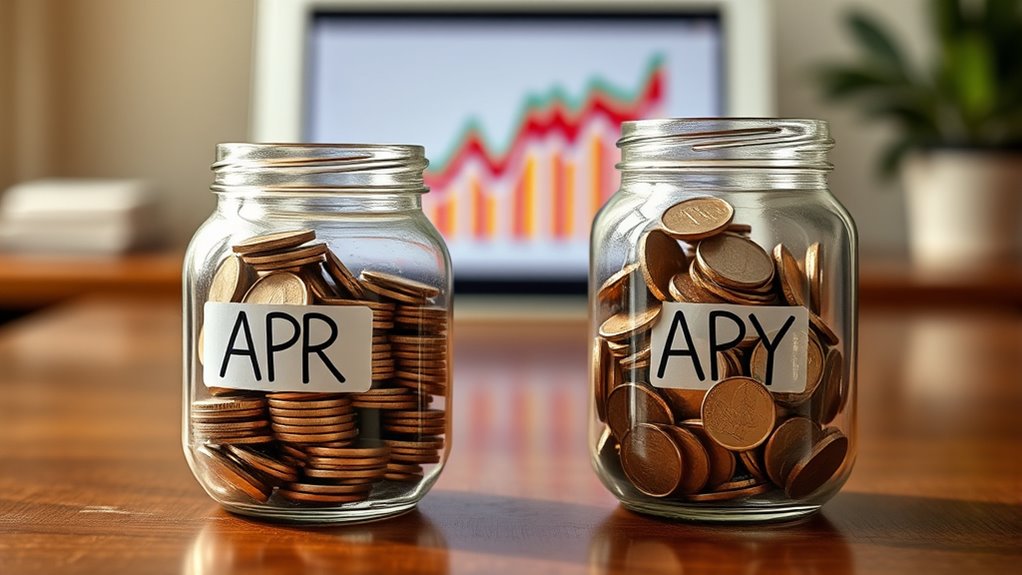
When comparing interest rates on savings accounts or loans, it’s vital to understand the difference between APR and APY. This knowledge can save you money and prevent surprises down the line. APR, or annual percentage rate, reflects the yearly cost of borrowing, including interest and any associated fees like annual fees. It’s often used for loans and credit cards to show you the total cost of borrowing over a year. APY, or annual percentage yield, measures how much your money grows in a year, factoring in compound interest, which is interest calculated on both the original amount and accumulated interest. Knowing how these two differ helps you make smarter financial decisions.
Understanding the difference between APR and APY helps you make smarter financial choices and avoid costly surprises.
APR doesn’t account for compounding, so it provides a straightforward view of the yearly interest rate without considering how often interest is compounded. For example, if a loan has a 10% APR, you’ll pay roughly that percentage over the year, but it doesn’t tell you how quickly that interest grows if it compounds more frequently, such as monthly or daily. On the other hand, APY includes the effect of compounding, so it shows a more accurate picture of how your savings or debt will grow or cost you over time. A higher APY means your savings will grow faster due to more frequent compounding, while a higher APR indicates more expensive borrowing.
It’s also vital to consider annual fees when evaluating different financial products. Some savings accounts or loans might advertise a low interest rate or APY but include hefty annual fees that eat into your returns or add to your costs. For example, a savings account might boast a 2% APY, but if it charges a $50 annual fee, your actual net gain is less. Similarly, a loan with a low APR but high annual fees could end up costing you more than a higher-interest option without fees. Always factor in these fees alongside the interest rates to get a realistic view of the total cost or benefit.
Understanding these differences helps you avoid costly mistakes. If you only look at APR, you might underestimate the true cost of borrowing, especially if interest compounds frequently or if annual fees are high. Conversely, focusing solely on APY without considering fees could lead you to overestimate your earnings on savings. By comparing both APR and APY and accounting for fees, you get a clearer picture of what’s truly at stake, allowing you to choose the most cost-effective options. Ultimately, grasping how compound interest and fees impact your finances ensures that you’re not just looking at numbers, but at the real costs and gains that affect your bottom line. Recognizing the interest compounding effect is crucial for understanding how your investments and debts grow over time.
Products Worth Considering

Apple iPad Air (2025) 13‑inch Wi‑Fi 256 GB – Space Gray (M3 chip)

Canon imagePROGRAF PRO-1100 Professional 17-Inch Wireless Inkjet Photo Printer Bundle

Apple iPad Pro 11-inch (M5), 256GB, Wi-Fi 7, Space Black
As an affiliate, we earn on qualifying purchases.
Frequently Asked Questions
How Does Compounding Frequency Affect APY Calculations?
You might wonder how compounding frequency affects APY calculations. When interest compounds more frequently, like daily instead of annually, the interest calculation accelerates, leading to a higher APY. This means your savings grow faster because the interest earned gets added to the principal more often. So, a higher compound frequency boosts your APY, maximizing your earnings, while a lower frequency results in less interest accumulated over time.
Can a Lower APR Still Result in Higher Overall Costs?
Imagine you’re in a time machine, and even with a lower APR, you might still end up paying more overall. Interest rate differences matter, especially over longer loan terms, because a seemingly smaller APR can compound costs. So, if you’re comparing loans, don’t just look at the rate—consider how the term impacts total payments, as a lower APR doesn’t always mean lower total costs in the end.
Are There Legal Differences Between APR and APY Disclosures?
You might wonder if there are legal differences between APR and APY disclosures. Legally, disclosure requirements specify how lenders must present these rates, with clear definitions of each. APR reflects the yearly cost of borrowing, including fees, while APY shows the actual annual return on savings. These legal definitions guarantee transparency, helping you compare loans and investments accurately. Knowing these differences helps you avoid surprises and make informed financial decisions.
How Do Promotional Rates Impact APR and APY Comparisons?
Promotional rates can make APR and APY comparisons tricky because they often offer lower rates initially, then increase later. When comparing rates, you need to take into account how long the promotional rate lasts and what the standard rate will be afterward. This helps you avoid surprises and make more accurate rate comparisons, ensuring you understand the true cost or earnings over time. Always check the terms to see how promotional rates impact your decision.
What Are Common Mistakes Consumers Make When Comparing These Rates?
Many consumers fall for rate misinterpretations and disclosure errors when comparing APR and APY. You might assume higher rates always mean better deals, but promotional rates can be misleading. Always verify if the rates are annual or promotional, and read the fine print. Avoid common mistakes by thoroughly comparing the terms, understanding compounding effects, and questioning unclear disclosures—this helps prevent costly surprises and makes your comparisons more accurate.
Conclusion
So, next time you see those tempting interest rates, remember: APR and APY are like that friend who’s always hiding something. Don’t get fooled by shiny numbers; dig a little deeper. Because, honestly, if you’re not paying attention, those tiny differences can turn your hard-earned cash into a lesson in financial comedy. Stay savvy, and don’t let the numbers play you—after all, your wallet deserves a bit more than a game of hide and seek.