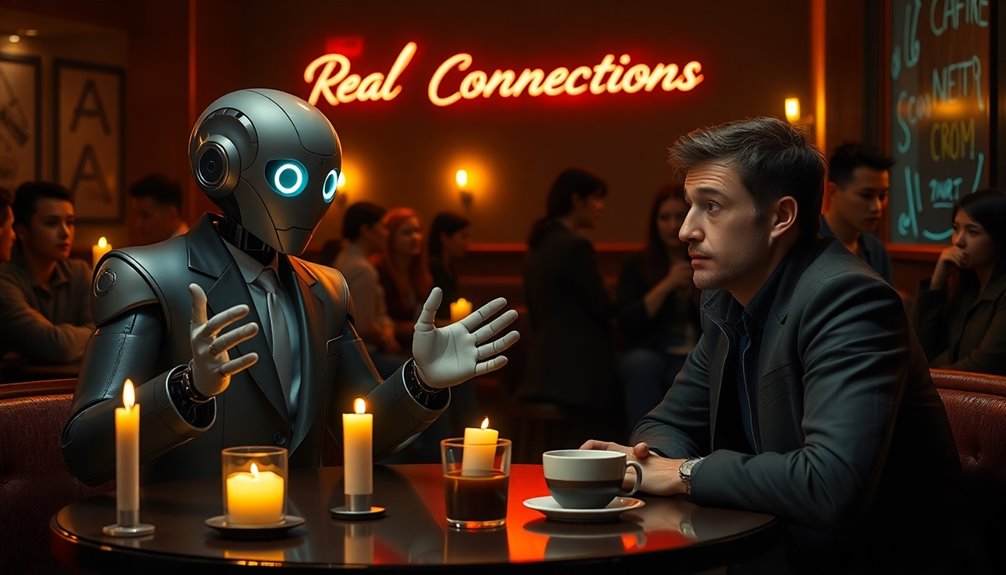

You find yourself sitting across from an AI, intrigued by its uncanny ability to engage in conversation. At first, it feels thrilling—this digital companion seems to know you so well. But as the date unfolds, a nagging discomfort creeps in. You wonder about the authenticity of its responses and your own feelings. What happens when the lines between reality and artificiality blur? The experience challenges your perception of connection in unexpected ways.
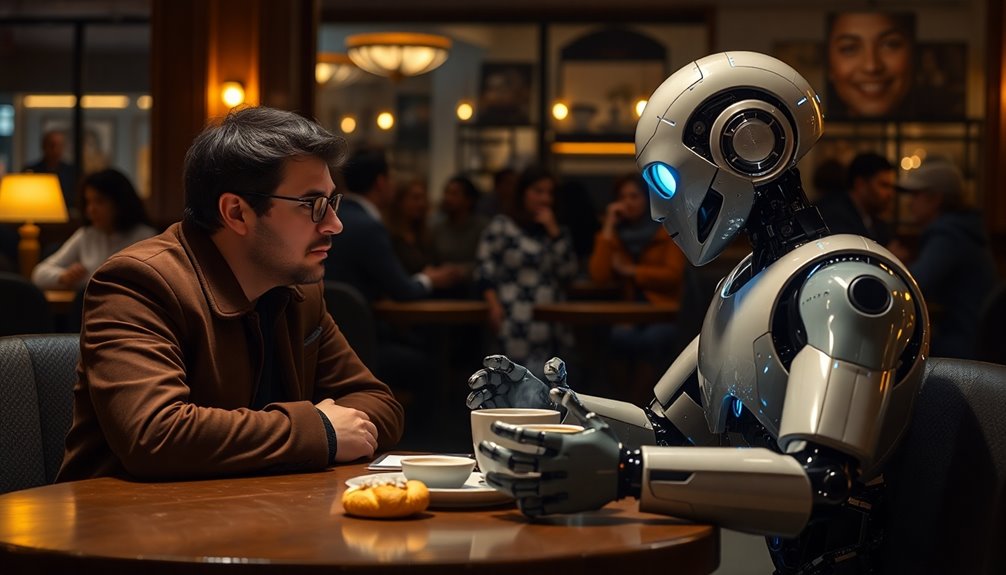
As technology advances, you might find yourself considering a date with an AI, where custom chatbots can provide a surprisingly realistic experience. Imagine diving into a world where apps like Replika allow you to create a romantic AI companion, complete with a human-like avatar for just $69.99 a year. It's a unique scenario that blends the thrill of dating with the convenience of technology, but it comes with its quirks.
When you first open an app like Blush, you'll notice how it serves as a dating simulator, designed to help you practice your relationship skills. It encourages self-reflection on your values and goals, making it feel like a supportive space. You can engage in text-based conversations, and some apps even offer voice or video chat features. It's almost like having a real date, yet you can't shake the feeling that you're talking to a well-programmed machine.
As you interact with these chatbots, you might find yourself forming unexpected emotional connections. Users often report feeling surprisingly attached to their AI companions, despite knowing they're not real people. This emotional bond can be comforting but also raises ethical questions about authenticity and the potential manipulation of feelings. Are you falling for the AI, or is it just a clever algorithm at play? The phenomenon of people falling in love with chatbots is documented.
The matchmaking algorithms in these apps analyze your data to create virtual matches, but their accuracy can vary. You may find a chatbot that resonates with you, leading to deeper conversations. However, it's crucial to remember that these AIs often lack memory retention, so they may not recall previous chats, which can disrupt the flow of your interactions. You might feel frustrated when the AI doesn't remember your last conversation, making it clear that you're still just chatting with a machine.
Ultimately, your experience with AI dating apps could revolutionize your approach to relationships. They offer a low-stakes environment to practice social skills and explore your dating preferences. As these technologies improve, you can expect even more realistic interactions in the future, but you'll also need to manage your expectations.
While your AI date might be a fun escape, it's essential to keep in mind the limitations and ethical implications of this new frontier in dating. So, if you're up for a unique experience, don't hesitate to give it a try, but be prepared for the weirdness that comes with it.
Top picks for "went realistic date"
Open Amazon search results for this keyword.
As an affiliate, we earn on qualifying purchases.