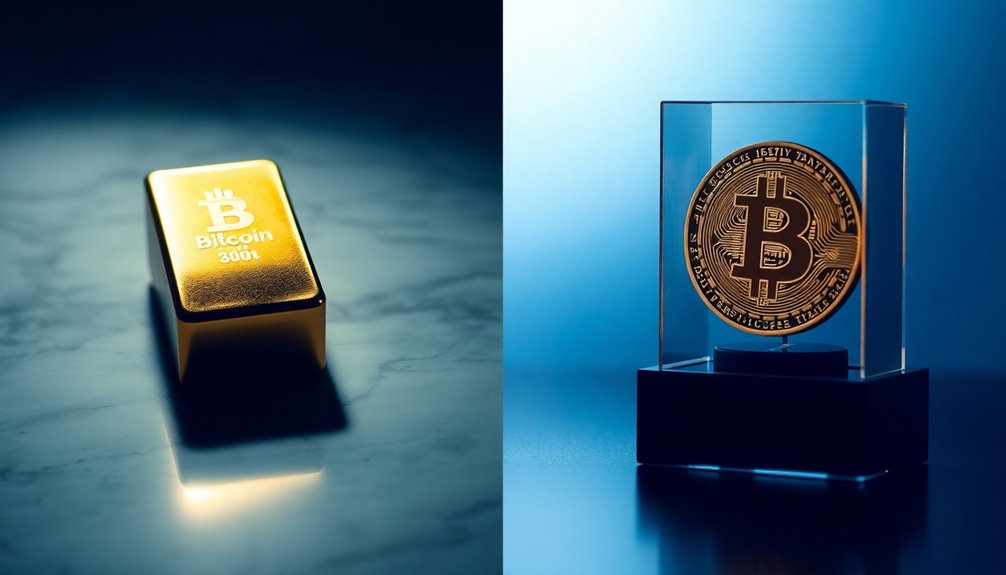

As you consider your investment options for 2025, the choice between Bitcoin and gold isn't straightforward. Gold has stood the test of time, providing stability and protection against inflation. On the other hand, Bitcoin's innovative nature and potential for high returns can be tempting. Each holds unique advantages, but which one aligns with your financial goals? The answer might not be what you expect.

When it comes to wealth protection, which is the better option: Bitcoin or gold? This question can spark heated debates among investors, especially as you weigh the historical performance and stability of both assets.
Gold has stood the test of time for over 4,000 years as a trusted store of value, offering consistent returns year after year. In contrast, Bitcoin's volatility can be thrilling yet nerve-wracking, with its prices often swinging dramatically. While Bitcoin has recently outperformed gold in terms of potential returns, its unpredictable nature can make you think twice. Bitcoin experienced exponential growth from $4 in 2011 to over $106,000 in 2024, representing a growth of over 2 million percent. Moreover, gold IRAs can provide a structured way to invest in gold while enjoying tax advantages.
When considering inflation-hedging capabilities, gold shines as a reliable choice. It's proven to be effective during economic crises, generating impressive returns during inflationary periods, such as 35% annually from 1973 to 1979.
Bitcoin, although it has a capped supply of 21 million coins that may suggest it could hedge against inflation, behaves more like a risk asset. You might find it appreciates during inflation but falters during financial uncertainty, which could be a concern if you're seeking stability.
Regulatory frameworks also play a significant role. Gold operates in a well-established environment, widely accepted by institutions and governments alike. This reliability makes it a cornerstone of institutional finance.
On the other hand, Bitcoin faces a turbulent regulatory landscape, with debates around taxation and oversight still ongoing. Although Bitcoin ETFs became available in 2024, marking a step toward institutional adoption, it still lacks the established trust that gold enjoys.
Technological advancements further complicate your decision. Bitcoin benefits from innovations like the Lightning Network, improving its usability and scalability.
However, gold's physical properties offer you a tangible asset that provides a sense of security, especially in uncertain times. As younger investors increasingly gravitate toward digital assets, Bitcoin's market influence might grow, potentially reaching a market cap of $21 trillion by 2030.
Ultimately, choosing between Bitcoin and gold for wealth protection hinges on your risk tolerance and investment goals. If you value stability and a long history of reliability, gold may align better with your needs.
However, if you're intrigued by growth potential and technological advancements, you might lean toward Bitcoin. In this safety showdown for 2025, consider what matters most to you, and make an informed choice.

Prestige ORO Premium Gypsum-Bonded Investment Powder – Smooth, Bubble-Free Castings for Gold, Silver, Brass & Bronze – 5 lb
PREMIUM QUALITY INVESTMENT: Gypsum-bonded powder for flawless castings of alloys up to 22K, including yellow & white gold,…
As an affiliate, we earn on qualifying purchases.
As an affiliate, we earn on qualifying purchases.

Bitkey Bitcoin Hardware Wallet – The Most Secure Way to Buy, Store and Manage Bitcoin
BITCOIN EXCLUSIVE: Bitkey is designed from the ground up exclusively for Bitcoin, offering a dedicated hardware wallet solution…
As an affiliate, we earn on qualifying purchases.
As an affiliate, we earn on qualifying purchases.

SHOP WGS Gold Bar 18K Yellow Gold Bullion Gold Bars for Collectible & Value Storage Gifts for Him & Her (12 Gram)
Authentic Solid Gold Bars – These gold bars made from real 10K, 14K or 18K gold. Certified for…
As an affiliate, we earn on qualifying purchases.
As an affiliate, we earn on qualifying purchases.

CryptoCurrency Investment Guide
As an affiliate, we earn on qualifying purchases.
As an affiliate, we earn on qualifying purchases.