

Investment property calculators range from real-estate-focused models with dedicated finance functions to general financial calculators built for broader analysis. I rank the Calculated Industries 3415 Qualifier Plus IIIx as the best overall for its real estate-specific focus, while the Calculated Industries 3405 Real Estate Master IIIx is a strong alternative for property calculations in a more compact format. The Texas Instruments BA II Plus stands out for buyers who want a general-purpose finance calculator rather than a property-specialized tool. The main tradeoff is between dedicated real estate functions, broader financial versatility, and the learning curve of each keypad and workflow. Read on for the full comparison and guidance on matching a calculator to your investing process.

Get smart everyday buys delivered free with Prime
- Fast, free delivery on millions of items
- Prime Video, Amazon Music and more included
- Member-only deals all year
Key Takeaways
- Real-estate-specific workflows lead the shortlist: The Calculated Industries Qualifier Plus and Real Estate Master models are the most directly aligned with property finance tasks.
- Calculator format changes the workflow: The desktop Qualifier Plus IIIfx favors a larger stationary setup, while the pocket Real Estate Master is built around portability.
- General finance models trade property specialization for range: The HP 12C and Texas Instruments BA II Plus options suit buyers who also need broader financial calculations.
- Several models share a family resemblance: Buyers should compare keypad layout and form factor within the Calculated Industries lineup, not assume similarly named models are interchangeable.
- Basic affordability is not the only value measure: The ROATEE and CATIGA options may suit simpler needs, while investors who rely on repeatable property workflows may benefit more from specialized functions.
| Calculated Industries 3415 Qualifier Plus IIIx Real Estate Finance Calculator |  | Best for Residential Loan Comparisons | Brand: Calculated Industries | Model: 3415 Qualifier Plus IIIx | Calculator type: Real estate finance calculator | VIEW LATEST PRICE | See Our Full Breakdown |
| Calculated Industries Qualifier Plus IIIfx Real Estate Calculator |  | Best for Investment Metrics in a Handheld Real Estate Calculator | Brand: Calculated Industries | Model: 3430 Qualifier Plus IIIfx | Functions: Mortgage, buyer qualification, cash flow, IRR, NPV, NFV, rent-versus-buy, commission, and date calculations | VIEW LATEST PRICE | See Our Full Breakdown |
| Calculated Industries Qualifier Plus IIIfx Desktop Real Estate Calculator |  | Best for Office-Based Property Analysis | Brand: Calculated Industries | Model: Qualifier Plus IIIfx Desktop | Calculator type: Real estate and mortgage finance | VIEW LATEST PRICE | See Our Full Breakdown |
| Calculated Industries 3405 Real Estate Master IIIx Finance Calculator |  | Best for Straightforward Mortgage Scenarios | Brand: Calculated Industries | Model: 3405 | Functions: Mortgage payments, amortization, remaining balances, adjustable-rate mortgages, combination loans, and interest-only payments | VIEW LATEST PRICE | See Our Full Breakdown |
| HP 12C Financial Calculator with Case and Cleaning Cloth |  | Best for Experienced Investors and Broader Financial Work | Brand: HP | Model: HP 12C | Calculator type: Financial | VIEW LATEST PRICE | See Our Full Breakdown |
| Texas Instruments BA II Plus Professional Financial Calculator |  | Best for Cash-Flow Analysis | Brand: Texas Instruments | Model: BA II Plus Professional | Display: 10-digit | VIEW LATEST PRICE | See Our Full Breakdown |
| Texas Instruments BA II Plus Financial Calculator | 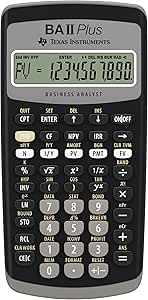 | Best Value for Core Investment Math | Manufacturer: Texas Instruments | Model: BA II Plus (IIBAPL/TBL/1L1/C) | Weight: 3.68 ounces | VIEW LATEST PRICE | See Our Full Breakdown |
| ROATEE Financial Calculator for Students and Professionals |  | Best Compact Alternative | Brand: ROATEE | Model: AC0601 | Display: 10-digit | VIEW LATEST PRICE | See Our Full Breakdown |
| CATIGA CF-300 Financial Calculator |  | Best for Protected Everyday Use | Brand: CATIGA | Model: CF-300 | Calculator type: Financial | VIEW LATEST PRICE | See Our Full Breakdown |
| Calculated Industries 3400 Pocket Real Estate Master Financial Calculator |  | Best for Mortgage and Amortization Tasks | Brand: Calculated Industries | Model: 3400 | Calculator type: Financial | VIEW LATEST PRICE | See Our Full Breakdown |
| HP 12C Platinum Financial Calculator with 130+ Functions |  | Best for Flexible Financial Analysis | Functions: 130+ | Entry modes: RPN and algebraic | Cash flow capacity: Up to 30 cash flows | VIEW LATEST PRICE | See Our Full Breakdown |
| investment property calculator | Model | Brand | Functions | Warranty |
|---|---|---|---|---|
| Calculated Industries 3415 Qua | 3415 Qualifier Plus IIIx | Calculated Industries | Mortgage payments, amortization, buyer pre-qualification, and loan comparisons | 1-year limited warranty |
| Calculated Industries Qualifie | 3430 Qualifier Plus IIIfx | Calculated Industries | Mortgage, buyer qualification, cash flow, IRR, NPV, NFV, rent-versus-buy, commission, and date calculations | 1 year |
| Calculated Industries Qualifie | Qualifier Plus IIIfx Desktop | Calculated Industries | Loan calculations, buyer qualifying, cash flows, IRR, NPV/NFV, and date math | — |
| Calculated Industries 3405 Rea | 3405 | Calculated Industries | Mortgage payments, amortization, remaining balances, adjustable-rate mortgages, combination loans, and interest-only payments | 1 year |
| HP 12C Financial Calculator wi | HP 12C | HP | 120+ | — |
| Texas Instruments BA II Plus P | BA II Plus Professional | Texas Instruments | TVM, amortization, depreciation, interest rate conversions, statistics, IRR, MIRR, NPV, NFV, modified duration, and payback | 1-year limited warranty |
| Texas Instruments BA II Plus F | BA II Plus (IIBAPL/TBL/1L1/C) | — | — | — |
| ROATEE Financial Calculator fo | AC0601 | ROATEE | — | 2 years |
| CATIGA CF-300 Financial Calcul | CF-300 | CATIGA | TVM, IRR, NPV, cash flow, amortization, bond pricing, depreciation, probability, and linear regression | 2 years |
| Calculated Industries 3400 Poc | 3400 | Calculated Industries | — | — |
| HP 12C Platinum Financial Calc | — | — | 130+ | — |
More Details on Our Top Picks
Calculated Industries 3415 Qualifier Plus IIIx Real Estate Finance Calculator
The Qualifier Plus IIIx is built around residential mortgage decisions: dedicated qualifying keys help compare payments and check whether a buyer fits a loan, while support for FHA, VA, adjustable-rate, and combination loans covers several common financing paths. That makes it more focused for buyer qualification than the Qualifier Plus IIIfx, whose listed functions extend to cash flow, IRR, and present and future values. For an investor comparing property returns across holding periods, those investment metrics may matter more than the IIIx’s loan emphasis. Its slide cover and quick reference guide help protect the unit and make its specialized workflow easier to learn. The tradeoff is a narrow real estate finance scope and button-cell power, so it is less suited to general calculations or broader investment analysis.
Pros:- Dedicated buyer-qualification keys support quick residential loan checks.
- Handles FHA, VA, adjustable-rate, and combination loan calculations.
- Supports mortgage payments, amortization, and loan comparisons.
- Includes a protective slide cover and two reference guides.
Cons:- Its feature set centers on residential finance rather than investment return analysis.
- Relies on button-cell batteries.
Best for: Residential property buyers, agents, and loan officers who regularly compare mortgage payments and pre-qualify borrowers across loan types.
Not ideal for: Rental investors who need cash-flow, IRR, or NPV analysis in the same calculator, or buyers seeking a general-purpose model.
- Brand:Calculated Industries
- Model:3415 Qualifier Plus IIIx
- Calculator type:Real estate finance calculator
- Functions:Mortgage payments, amortization, buyer pre-qualification, and loan comparisons
- Loan types:FHA, VA, adjustable-rate, and combination loans
- Weight:91 g
- Power:Long-life button-cell batteries
- Warranty:1-year limited warranty
- Included accessories:Protective slide cover, quick reference guide, pocket user’s guide, and batteries
Our verdict“Choose the Qualifier Plus IIIx for hands-on residential loan comparisons; pick the Qualifier Plus IIIfx if investment cash-flow metrics matter more.”
Calculated Industries Qualifier Plus IIIfx Real Estate Calculator
For an investor who wants mortgage calculations and return analysis in one handheld tool, the Qualifier Plus IIIfx has a wider reach than the 3415 Qualifier Plus IIIx. Alongside buyer qualification and loan comparisons, it includes cash flow, IRR, NPV, and NFV, functions that help compare projected property outcomes rather than payments alone. Its rent-versus-buy and commission calculations also make it useful to professionals who move between investment and transaction questions. The tradeoff is that this is still a specialized real estate calculator, and the listing does not give the desktop model’s adjustable display and large-key emphasis. Buyers who need a more office-oriented layout may prefer the IIIfx Desktop; those who mainly need straightforward residential loan work can choose the narrower IIIx. A tool-secured battery compartment adds a layer of protection but takes a tool to open.
Pros:- Combines mortgage and buyer qualification functions with cash-flow analysis.
- Includes IRR, NPV, and NFV for evaluating projected investment outcomes.
- Adds rent-versus-buy, commission, and date calculations.
- Comes with a protective slide cover and reference guides.
Cons:- Specialized real estate functions may be less useful for general financial or everyday calculations.
- The battery compartment requires a tool to open.
Best for: Real estate investors, brokers, or loan professionals who need handheld mortgage, cash-flow, and IRR calculations for property comparisons.
Not ideal for: Users who want a general-purpose calculator or prefer a desktop layout with large keys and an adjustable display.
- Brand:Calculated Industries
- Model:3430 Qualifier Plus IIIfx
- Functions:Mortgage, buyer qualification, cash flow, IRR, NPV, NFV, rent-versus-buy, commission, and date calculations
- Included:Protective slide cover, quick reference guide, pocket user’s guide, and battery
- Warranty:1 year
- Battery safety:Button-cell compartment secured with a tool-required fastener
- UPC:73509080
Our verdict“Pick the handheld IIIfx when property cash flow and return metrics matter alongside mortgage work; choose the IIIx for a simpler loan-focused workflow.”
Calculated Industries Qualifier Plus IIIfx Desktop Real Estate Calculator
The desktop IIIfx suits investors and real estate professionals who work through figures at a desk and want mortgage qualification alongside investment metrics. Its cash-flow, IRR, NPV, and NFV functions let users compare projected property returns, while large keys and an adjustable display favor longer sessions over portability. The handheld Qualifier Plus IIIfx offers a similar mix of real estate finance functions in a more portable form; this desktop version makes more sense when the calculator is a regular workspace tool. It also handles date math and buyer qualification, bridging loan comparisons with investment analysis. Its limits are clear: it is specialized for real estate and mortgage finance, and the button-cell compartment requires a tool to access. Investors who need a compact carry-around calculator may find the 3415 easier to bring along, though it lacks the desktop listing’s emphasis on IRR and NPV.
Pros:- Combines loan and buyer qualification calculations with cash-flow analysis.
- IRR, NPV, and NFV functions support property investment comparisons.
- Large keys and an adjustable display suit desk-based work.
- Includes date math, a protective cover, and reference guides.
Cons:- Its real estate and mortgage focus limits its usefulness for general calculations.
- The button-cell battery compartment requires a tool to access.
Best for: Property managers, brokers, and investors who regularly model loans and property cash flows at a desk and value larger keys.
Not ideal for: Investors who need a pocketable calculator for site visits or want broad general-purpose calculation features.
- Brand:Calculated Industries
- Model:Qualifier Plus IIIfx Desktop
- Calculator type:Real estate and mortgage finance
- Functions:Loan calculations, buyer qualifying, cash flows, IRR, NPV/NFV, and date math
- Display:Adjustable
- Included accessories:Protective slide cover, quick reference guide, pocket user’s guide, and battery
- Unit count:1
Our verdict“Choose the desktop IIIfx for regular desk-based loan and return modeling; the handheld IIIfx is a better fit for work away from the office.”
Calculated Industries 3405 Real Estate Master IIIx Finance Calculator
The Real Estate Master IIIx is a focused choice for buyers and small-scale investors who need to work through mortgage structures without a wider investment-analysis toolkit. Clearly labeled keys cover payments, amortization, remaining balances, adjustable-rate mortgages, combination loans, and interest-only payments. That makes it more directly organized around loan scenarios than the HP 12C, which offers broader financial functions such as IRR and NPV but uses RPN entry. The tradeoff for this simpler mortgage focus is that the supplied product data does not list cash-flow or IRR functions, so evaluating a rental’s projected return may require another tool. Its slide cover and pocket guide support a portable, task-specific workflow, and its 91 g weight keeps it light. Investors comparing multiple properties on return metrics may be better served by the Qualifier Plus IIIfx.
Pros:- Clearly labeled keys make common mortgage calculations easier to access.
- Supports adjustable-rate, combination, and interest-only loan scenarios.
- Calculates amortization and remaining balances.
- Includes a protective slide cover and reference guides.
Cons:- The listed functions focus on residential mortgage finance rather than investment returns.
- Product data does not specify cash-flow, IRR, or NPV functions.
Best for: Home buyers, agents, and smaller landlords who primarily need mortgage payment, amortization, and loan-structure calculations.
Not ideal for: Investors who need to compare rental cash flows, IRR, or NPV without using a second calculator.
- Brand:Calculated Industries
- Model:3405
- Functions:Mortgage payments, amortization, remaining balances, adjustable-rate mortgages, combination loans, and interest-only payments
- Weight:91 g
- Unit count:1
- Warranty:1 year
- Included accessories:Protective slide cover, quick reference guide, pocket user’s guide, and two batteries
Our verdict“Choose the 3405 for clear, portable mortgage scenario work; select the Qualifier Plus IIIfx when property return analysis is part of the job.”
HP 12C Financial Calculator with Case and Cleaning Cloth
The HP 12C is the broadest financial tool in this group, with 120+ functions spanning amortization, bonds, depreciation, NPV, and IRR. For an investment property buyer, those return and depreciation calculations can help extend analysis beyond mortgage payments, while programmable keystroke sequences support repeat calculations. Compared with the real estate-specific Qualifier Plus IIIfx, though, the HP 12C is not presented with dedicated buyer-qualification keys or a tailored real estate workflow. Its RPN entry method can reduce keystrokes for people familiar with it, but it adds a learning curve for users accustomed to standard algebraic entry. The plastic case, carrying case, and cleaning cloth suit regular travel, while the nonstandard battery is a practical replacement constraint. This is a more flexible pick for experienced finance users, not the most direct option for quick mortgage qualification.
Pros:- Offers 120+ financial and statistical functions, including NPV, IRR, and depreciation.
- RPN entry can reduce keystrokes for users familiar with the method.
- Programmable sequences can repeat routine financial calculations.
- Includes a carrying case, cleaning cloth, and pre-installed battery.
Cons:- RPN entry may take time to learn for users accustomed to standard calculator input.
- Requires a nonstandard battery.
Best for: Experienced property investors and finance professionals who want a programmable calculator for mortgage, return, depreciation, and other financial work.
Not ideal for: First-time buyers who want dedicated real estate keys or users who prefer standard algebraic entry over RPN.
- Brand:HP
- Model:HP 12C
- Calculator type:Financial
- Functions:120+
- Entry method:RPN
- Programmable:Yes
- IRR/NPV cash flows:Up to 20
- Power and display:Battery powered; LCD
- Dimensions and warranty:6 × 3 in; 2 years
Our verdict“Choose the HP 12C for broad, programmable financial analysis if you are comfortable with RPN; choose the Qualifier Plus IIIfx for a more direct real estate workflow.”
Texas Instruments BA II Plus Professional Financial Calculator
For buyers comparing properties through uneven income and expense schedules, the BA II Plus Professional offers the deepest cash-flow toolkit in this group. It handles up to 32 uneven cash flows and calculates IRR, MIRR, NPV, NFV, and payback, giving investors more ways to compare a renovation, rent-up period, or resale scenario than the mortgage-focused Calculated Industries 3400. Its TVM, depreciation, and modified-duration functions also suit users who analyze financing alongside broader investment measures. The prompted display can help guide inputs, though it does not remove the learning curve: specialized worksheets and functions take practice. Compared with the standard BA II Plus, this Professional version is the stronger fit for complex cash-flow work, but may be more calculator than a buyer needs for basic payment estimates.
Pros:- Analyzes up to 32 uneven cash flows with frequency support
- Calculates IRR, MIRR, NPV, NFV, and payback
- Includes depreciation, amortization, and time-value-of-money functions
- Prompted display can guide users through supported calculations
Cons:- Specialized functions and workflows require time to learn
- Its broad finance toolkit may be unnecessary for simple mortgage estimates
Best for: Property investors and finance students who compare deals using uneven cash flows, NPV, IRR, or payback calculations
Not ideal for: Buyers who mainly need quick mortgage-payment and balance calculations, since its broader financial functions take time to learn
- Brand:Texas Instruments
- Model:BA II Plus Professional
- Display:10-digit
- Cash-flow capacity:Up to 32 uneven cash flows with up to 4-digit frequencies
- Functions:TVM, amortization, depreciation, interest rate conversions, statistics, IRR, MIRR, NPV, NFV, modified duration, and payback
- Power management:Automatic Power Down
- Warranty:1-year limited warranty
Our verdict“Choose the BA II Plus Professional if your property comparisons depend on detailed, uneven cash-flow analysis rather than mortgage calculations alone.”
Texas Instruments BA II Plus Financial Calculator
The standard BA II Plus covers the calculations many rental-property buyers actually need—time value of money, NPV, IRR, amortization, and compound interest—without the Professional model’s expanded cash-flow capacity. Its worksheets for bonds and depreciation add useful flexibility when comparing financing or tax-related assumptions, while stored worksheet values can save re-entry when you revisit scenarios. That makes it a practical middle ground between the real-estate-specific Calculated Industries 3400 and the more elaborate BA II Plus Professional. It is also approved for CFA, GARP FRM, and Certified Management Accountants exams, which may appeal to students using one calculator for coursework and deal analysis. The tradeoff is a learning curve: worksheets are capable, but the calculator does not make complex inputs self-explanatory.
Pros:- Handles TVM, NPV, IRR, and common loan calculations
- Worksheets cover amortization, bonds, depreciation, and compound interest
- Retains previous worksheet values in memory
- Approved for CFA, GARP FRM, and Certified Management Accountants exams
Cons:- Advanced worksheets can take time to learn
- Does not offer the Professional model’s stated capacity for up to 32 uneven cash flows
- Less tailored to property-specific mortgage tasks than the Calculated Industries 3400
Best for: Rental-property buyers, finance students, and small investors who want core loan and cash-flow calculations in a general financial calculator
Not ideal for: Investors who need extensive uneven-cash-flow modeling or prefer dedicated real-estate keys for mortgage tasks
- Manufacturer:Texas Instruments
- Model:BA II Plus (IIBAPL/TBL/1L1/C)
- Weight:3.68 ounces
- Dimensions:6.48 × 2.98 × 0.72 inches
- Material:ABS plastic
- Battery:1 CR123A battery, included
- Statistical functions:One- and two-variable statistics with four regression options
- Approved exams:CFA, GARP FRM, and Certified Management Accountants exams
Our verdict“Pick the standard BA II Plus for a versatile set of core investment calculations if you do not need the Professional model’s larger cash-flow toolkit.”
ROATEE Financial Calculator for Students and Professionals
The ROATEE AC0601 packs a broad range of financial calculations into a light, slim body, making it a portable option for buyers who want to run loan and cash-flow figures away from a desk. Its listed functions include TVM, amortization, NPV, IRR, bond pricing, depreciation, and regression, so it reaches beyond the dedicated mortgage focus of the Calculated Industries 3400. Ten independent memories and customizable settings can help users keep frequently used values and tailor the calculator to their workflow. At 3.25 ounces, it is lighter than the standard BA II Plus listed here. The compromise is a 3-inch screen and button-cell power: the compact format may feel cramped during longer sessions, and its two LR44/AG13 batteries are less familiar than common household cells.
Pros:- Combines TVM, loan, amortization, cash-flow, NPV, and IRR functions
- Offers 10 independent memories and customizable settings
- Compact dimensions and 3.25-ounce weight suit travel
- Includes a storage pouch and user manual
Cons:- The 3-inch screen may feel small for frequent or extended use
- Requires two LR44/AG13 button-cell batteries
- Its broad function set may take time to learn
Best for: Mobile property buyers and students who want a lightweight calculator for loan, cash-flow, and statistical work
Not ideal for: Users who prefer a larger viewing area or want a calculator powered by more widely available battery types
- Brand:ROATEE
- Model:AC0601
- Display:10-digit
- Screen size:3 inches
- Memory:10 independent memories
- Dimensions:6.2 × 3.1 × 0.4 inches
- Weight:3.25 ounces
- Power source:Two LR44/AG13 button-cell batteries
- Warranty:2 years
Our verdict“Choose the ROATEE if portability and a wide set of financial functions matter more to you than a larger display or property-specific controls.”
CATIGA CF-300 Financial Calculator
The CATIGA CF-300 brings core property-investment math—TVM, cash flow, NPV, IRR, amortization, and depreciation—together with a flip-open hard case. That cover is a practical advantage for buyers who carry a calculator between property visits, classes, or an office, while its bond-pricing and statistical functions give it broader use than the mortgage-centered Calculated Industries 3400. The listed function set overlaps with the Texas Instruments BA II Plus, so the choice rests more on handling and protection than on a distinctly real-estate-specific workflow. Its 2-inch LCD is the main compromise: it may be less comfortable for reading inputs during longer calculations. The source data also describes it as battery-powered without specifying battery type or whether one is included.
Pros:- Covers TVM, cash flow, NPV, IRR, amortization, and depreciation
- Adds bond pricing, probability, and linear regression functions
- Flip-open hard case helps protect the calculator during transport
- Designed for finance, accounting, business, and exam use
Cons:- The 2-inch LCD may feel cramped during longer calculation sessions
- Battery type and inclusion are not specified in the provided product data
- Its listed functions are broad but do not establish a property-specific advantage over general financial calculators
Best for: Property buyers and students who want common investment calculations in a calculator with a protective hard case
Not ideal for: Users who need a larger display, solar power, or clearly specified battery details before buying
- Brand:CATIGA
- Model:CF-300
- Calculator type:Financial
- Power source:Battery powered
- Display:2-inch LCD
- Dimensions:6.46 × 3.15 inches
- Functions:TVM, IRR, NPV, cash flow, amortization, bond pricing, depreciation, probability, and linear regression
- Warranty:2 years
- Included:Flip-open hard case
Our verdict“Choose the CATIGA CF-300 if you want broad everyday financial functions and a protective case, and can work comfortably with a small LCD.”
Calculated Industries 3400 Pocket Real Estate Master Financial Calculator
For buyers focused on payment size, loan balance, and amortization rather than broad portfolio analysis, the Calculated Industries 3400 is the most directly property-oriented pick in this batch. Dedicated keys make common real-estate calculations more accessible than the worksheet-based approach of the Texas Instruments BA II Plus, and its functions include mortgage payments, loan amounts, interest, remaining balances, future values, and dates. At five inches long and four ounces, it is also suited to carrying between appointments; a hard case and included battery help make it ready for that use. Its narrow focus is the tradeoff. Unlike the BA II Plus Professional or CATIGA CF-300, the listed functions do not include NPV, IRR, or a broad statistical toolkit, so investors analyzing uneven cash flows may want a more general financial calculator.
Pros:- Dedicated keys simplify common mortgage and real-estate calculations
- Calculates loan amounts, interest, amortization, and remaining balances
- Includes future-value and date calculations
- Comes with a protective hard case, user guide, and battery
Cons:- Designed for real-estate and financial calculations rather than general-purpose use
- The listed functions do not include NPV or IRR for broader investment analysis
- LCD screen details are limited in the provided product information
Best for: Rental-property buyers and real-estate professionals who routinely calculate mortgage payments, amortization, and remaining balances
Not ideal for: Investors who need NPV, IRR, or extensive cash-flow and statistical analysis for comparing deals
- Brand:Calculated Industries
- Model:3400
- Calculator type:Financial
- Power source:Battery powered
- Battery:1 CR2 battery, included
- Display:LCD
- Screen size:2.5 inches
- Dimensions:5 inches long
- Weight:4 ounces
Our verdict“Choose the 3400 if mortgage and amortization calculations are your main property-analysis tasks, not full cash-flow comparisons.”
HP 12C Platinum Financial Calculator with 130+ Functions
For investors who want to calculate returns as well as loan payments, the HP 12C Platinum brings more range than a dedicated real-estate calculator. Its 130+ functions include IRR and NPV, useful for comparing projected cash flows across an investment, while support for up to 30 cash flows adds room for multi-period scenarios. Unlike the Calculated Industries 3415 Qualifier Plus IIIx, which is built around real-estate finance workflows, this HP is a broader financial tool rather than a property-specific shortcut.
The choice of RPN or algebraic entry lets users work in their preferred style, and Undo and Backspace help fix input errors. The tradeoff is a steeper learning curve for casual buyers, and its 400-step memory and cash-flow limit may constrain especially detailed models. I would choose it for flexible on-the-go calculations, not as a replacement for spreadsheet analysis or a property-focused calculator.
Pros:- Handles a broad range of financial calculations, including IRR and NPV.
- Offers both RPN and algebraic entry modes.
- Undo and Backspace keys make correcting entries easier.
- Includes a protective case, cleaning cloth, and preinstalled batteries.
Cons:- Advanced functions can make routine property calculations harder for casual users.
- The 30-cash-flow capacity may be limiting for investors modeling many periods or scenarios.
- A general-purpose financial layout lacks the property-specific workflow of the Calculated Industries 3415 Qualifier Plus IIIx.
Best for: Real-estate investors and finance professionals who want a handheld calculator for loan math, IRR, NPV, and other financial calculations.
Not ideal for: First-time landlords who mainly need straightforward property-finance shortcuts and do not want to learn advanced calculator functions.
- Functions:130+
- Entry modes:RPN and algebraic
- Cash flow capacity:Up to 30 cash flows
- Memory:400 steps
- Included accessories:Protective case, cleaning cloth, preinstalled batteries
- Correction keys:Undo and Backspace
- Financial functions:Includes IRR and NPV
Our verdict“Choose the HP 12C Platinum if you need flexible financial analysis beyond property-loan calculations and are comfortable learning its advanced functions.”

How We Picked
I ranked these calculators by how directly their functions support real estate finance work, how readily a buyer can use them for recurring investment calculations, and how well their format fits a desk, field visit, or general financial toolkit. I also weighed versatility, portability, and the likely learning curve. A calculator built specifically around real estate tasks earned an advantage for property-focused buyers; broader financial models remained strong options when their wider scope was more useful than a dedicated property workflow.
The order reflects those differences rather than treating every model as a substitute for every other one. The Qualifier Plus IIIx leads for its focused role, while other Calculated Industries models serve distinct preferences for desktop use, pocket portability, or a different real estate calculator format. The HP and TI models rank as versatile finance alternatives, and the more general student-and-professional options suit buyers with simpler needs. Before choosing, I would confirm the functions and operating method that matter to my own calculations, since similar labels do not guarantee identical workflows.
| investment property calculator | Brand |
|---|---|
| Calculated Industries 3415 Qua | Calculated Industries |
| Calculated Industries Qualifie | Calculated Industries |
| Calculated Industries Qualifie | Calculated Industries |
| Calculated Industries 3405 Rea | Calculated Industries |
| HP 12C Financial Calculator wi | HP |
| Texas Instruments BA II Plus P | Texas Instruments |
| Texas Instruments BA II Plus F | — |
| ROATEE Financial Calculator fo | ROATEE |
| CATIGA CF-300 Financial Calcul | CATIGA |
| Calculated Industries 3400 Poc | Calculated Industries |
| HP 12C Platinum Financial Calc | — |
Factors to Consider When Choosing Investment Property Calculators
Choosing among investment property calculators starts with the calculations you repeat, not with the longest feature list. I would match the calculator to my deal-screening routine, financing questions, and preferred way of entering numbers, then weigh portability and learning time.
Match the calculator to your recurring property questions
Start by listing the questions you answer for each potential deal: loan payments, financing scenarios, rental income, or other property finance figures. A real-estate-focused calculator may make repeated property workflows more direct, while a general financial model can suit investors who already work comfortably with finance functions. A common mistake is buying for a rare calculation while overlooking the inputs used on every property. Check the exact functions and terminology in the product documentation before deciding that a model covers your workflow. If your analysis depends on spreadsheet-based cash-flow assumptions, a handheld calculator may complement that process rather than replace it. The right fit is the one that reduces friction in your existing screening routine.
Choose a keypad and operating method you can use reliably
Financial calculators can differ in how they handle entries and sequences, so a familiar brand name does not remove the need to learn a model. If you switch from another calculator, confirm whether the key layout and calculation flow feel intuitive to you. Repeated property analysis rewards consistency: an unfamiliar method can slow comparisons and create avoidable input errors. Before buying, review the manual or a reliable demonstration and try a representative calculation if possible. Do not assume that a larger function count means a better experience for your everyday tasks. Paying for a workflow you can operate confidently may matter more than having seldom-used functions available.
Decide where the calculator will be used
A desk-based investor may prefer a larger calculator that stays in one place, while an investor comparing properties on the move may value a pocket format. Portability can make quick checks easier during visits, but a compact body may mean smaller keys or a different feel for extended use. A desktop model can be more comfortable for repeated entries yet less convenient to carry. Think about whether you will use the calculator alongside notes, a laptop, or printed deal sheets. Buyers sometimes focus only on dimensions and forget that keypad spacing and screen readability also shape day-to-day comfort. Choose the format around your actual work setting rather than the idea of portability alone.
Balance property specialization against broader finance use
A dedicated real estate calculator is appealing when property finance is the main job, while a general financial calculator can serve multiple finance-related tasks. Investors who also study finance or analyze non-property decisions may get more use from a broader model. The tradeoff is that general-purpose capability may not offer the same property-centered workflow as a specialized unit. Avoid paying for breadth you will rarely use, but do not narrow your choice so much that other regular tasks require a second tool. Consider the range of calculations you expect to handle over the next few years, not just your next purchase. That horizon can clarify whether specialization or versatility is the stronger fit.
Account for learning time and verification
A calculator can produce useful outputs only when the inputs, settings, and sequence are understood. New investors should leave time to learn the operating method and verify results against a trusted calculation or spreadsheet before relying on it for a decision. This is particularly helpful when comparing several financing scenarios, where a small input difference can change the output. Keep a written record of assumptions such as loan terms and recurring costs so the calculator is not asked to supply context it cannot know. A simpler tool may be a better first purchase if its workflow is easier for you to follow. Experienced users may prefer a specialized or broader model once their recurring process is clear.
Judge value by fit, not function count
Investment property analysis depends on how well a calculator supports your decisions, not on how many functions appear on its feature list. A less specialized option may be enough for occasional finance checks, while a dedicated model can make repeated property calculations more convenient. Compare the capabilities you will use with the cost of learning and carrying the device, without treating either feature volume or a low purchase price as proof of value. Also check what is included, such as a case, and whether the physical design suits your work habits. If two models meet your needs, favor the one whose layout is easier to operate accurately. That approach helps avoid paying for unused scope or choosing a tool you find cumbersome.
Frequently Asked Questions
Should I choose a real-estate-specific calculator or a general financial calculator?
I would choose a real-estate-specific model if property finance calculations make up most of my routine and I want a workflow centered on that use. A general financial calculator can be a better fit if I also handle broader finance tasks or prefer a familiar general-purpose tool. The distinction is less about which type is universally better and more about which one reduces repeated steps for my work. Compare the functions you actually use and check how each model handles them. If uncertain, prioritize the calculation you perform most often rather than buying based on a long feature list.
Can a financial calculator replace a spreadsheet for evaluating a rental property?
A handheld calculator can help with finance calculations and quick scenario checks, but it does not automatically replace a spreadsheet that tracks a full set of property assumptions. A spreadsheet can organize multiple income and expense categories, document changes, and compare properties side by side. A calculator is useful when you want a focused calculation or a quick independent check. Many buyers will benefit from using both tools for different parts of the process. Confirm what your chosen calculator can calculate before relying on it for a complete deal analysis.
Is a pocket model a good choice for property visits?
A pocket calculator can make quick checks convenient when you are away from your desk, especially if you compare financing figures while viewing properties. Portability is less helpful if the keys or display are uncomfortable for the amount of data you enter. Consider whether you will use it for brief checks or longer analysis sessions. A larger desktop format may be easier for repeated work at home, while a pocket model may fit an on-the-go routine better. If possible, inspect the keypad dimensions and layout before choosing based on portability alone.
Do similarly named Calculated Industries models perform the same job?
No; a shared brand or product-family name does not mean every model has the same format, functions, or workflow. The lineup includes real estate calculators with different designs, including a desktop version and a pocket option. Compare the exact model name and documentation rather than assuming one model is simply a size change of another. This matters if you depend on a particular calculation or prefer a certain keypad layout. I would confirm the functions and physical format that matter before selecting among the closely named options.
What should a first-time investor prioritize when choosing a calculator?
A first-time investor should prioritize a clear operating method and the calculations they will use repeatedly, rather than choosing the model with the broadest feature set. Learning how to enter figures and verify outputs is part of using any financial calculator responsibly. A specialized model may make property tasks more direct, while a simpler general finance option can be enough for occasional checks. Pair calculator results with a written list of assumptions and a broader property budget. If a model’s workflow is difficult to follow, its extra capabilities may not help in practice.
Conclusion
For most property-focused buyers, I recommend the Calculated Industries 3415 Qualifier Plus IIIx as the best overall because this roundup prioritizes a real-estate-centered workflow. The best value depends on how much specialization you need: the ROATEE or CATIGA may suit simpler, occasional calculations, while the Qualifier Plus IIIfx is a stronger match for recurring property finance work. For a best premium-style choice, consider the HP 12C or HP 12C Platinum if broad financial functions and a distinct finance-calculator format matter more than dedicated real estate workflow. Beginners should prioritize a keypad and operating method they can learn and verify, rather than the longest function list. For specific needs, choose the desktop Qualifier Plus IIIfx for a stationary setup, the pocket Real Estate Master for portability, or the TI BA II Plus models for general financial use. The best pick is the one that fits the calculations you repeat and the way you work through a deal.
Halloween Picks

12.2 ft Halloween Inflatable Outdoor Decoration – Giant Pumpkin

8.5 Foot Halloween Inflatable Haunted House Castle with Skeleton, Ghost & Skulls

12-Foot Inflatable Pumpkin Halloween Archway with LED Lights
As an affiliate, we earn on qualifying purchases.