
TL;DR

Get smart everyday buys delivered free with Prime
- Fast, free delivery on millions of items
- Prime Video, Amazon Music and more included
- Member-only deals all year
IdeaClyst acts as a digital war room where founders can quickly validate ideas with a structured council of AI advisors and real-time research. It makes decision-making transparent, collaborative, and data-driven, saving time and money before building begins.
Ever sit in front of a blinking cursor, unsure if your next idea is worth six months of your life? Or worse, launch something no one wants? That gut feeling isn’t enough anymore. The real game-changer is a space—virtual or physical—that keeps your ideas visible, debated, and refined in real time. That’s what IdeaClyst offers: a digital war room designed for founders who want clarity, speed, and confidence before they build.
Imagine having a dedicated space where your early ideas are scrutinized from multiple angles, grounded in live research, and documented in clear, shareable plans. No more guessing, no more hope-based decisions. This isn’t just a tool—it’s a strategic environment that turns your scattered thoughts into a coherent roadmap, saving you time, money, and sleepless nights.
A war room for your next idea
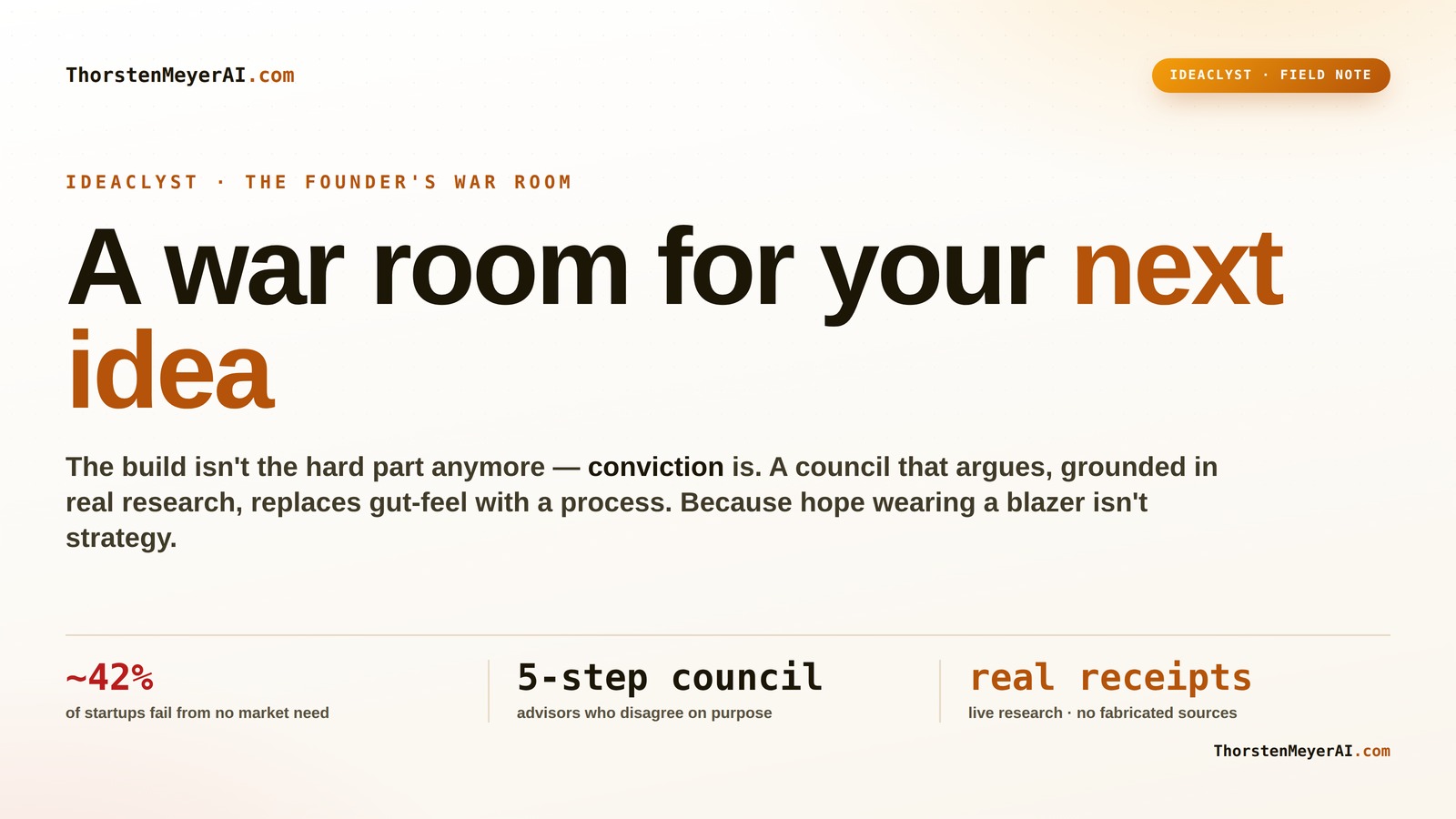
The build isn’t the hard part anymore — conviction is. Knowing which idea deserves the next six months, and being able to defend it. Most founders answer with gut feel and optimistic math. That’s hope wearing a blazer. IdeaClyst replaces it with a process.
The most expensive decision is what to build
The single most valuable thing a tool can do is talk you out of the wrong six months. The numbers make the case better than any pitch.
Three tools in one — on your own machine
Strip away the framing and IdeaClyst is three things at once, all running locally with nothing leaving your laptop.
An AI council
Pressure-tests an idea you bring it — advisors who argue on purpose.
A discovery engine
Finds ideas you didn’t know to look for by hunting real demand signals.
A founder’s workspace
Carries winners from “interesting” all the way to “ready to build.”
Advisors who disagree on purpose
Not one confident, agreeable answer — a structured five-step deliberation where models play different roles and turn on their own work. The disagreement is the feature.
The five-step deliberation
A council that leads with the bad news surfaces the objections you’d otherwise find the expensive way, on month five.
Product strategy
Who’s it for, what’s the wedge, why now, what’s the business model.
Technical architecture
What would it actually take to build — and where’s the risk.
Critique pass
The council turns on its own work. Where’s the hand-waving? What kills this?
Second, independent critique
A different voice, a different angle — so blind spots don’t survive.
Final synthesis
Everything into one coherent founder packet: strategy, architecture, validation, plan.
When IdeaClyst cites a source, it actually fetched it
The hard departure from “ask an AI what it thinks of my startup.” It runs in a strict, real-data-only mode — if it can’t gather genuine evidence, it says so plainly rather than inventing a plausible paragraph.
Confidence with receipts
No fabricated statistics, no imaginary competitors, no made-up citations. The packet survives a skeptical co-founder or a sharp investor because the reasoning has receipts.
Market research first
Scouts the landscape before the council reasons about anything.
Competitor read
Real positioning, pricing signals, feature claims — differentiation vs. reality.
Validation with links
Not “talk to customers” — concrete signals & sources you can click.
From the blank page to build-ready
Evaluation is half the problem; the blank page is the other half. And a plan is worthless if it dies in a tab you never reopen.
Bring a space, not an idea
“AI for accountants,” “tools for indie game studios” — plus your goal and real capacity. It hunts demand signals across HN, Reddit, Product Hunt, GitHub, pricing pages.
- An honest market read — leads with the bad news when a space is hard
- An opportunity map — high pain, thin competition
- Ranked candidates — wedge, who pays, effort, risk, confidence
- each with KILL CRITERIA — when to walk away
A home and a forward path
Every promising idea gets carried forward, with every artifact in plain files on your disk.
- Validation tooling — sprint board, interview list, evidence browser
- Founder profile — a personal-fit lens; same discovery, different advice
- Build workspaces — funnel, personas, landing draft, version history
- “Build this idea” → a PRD + task queue, ready for a coding agent
Key Takeaways
- IdeaClyst acts as a structured, local-first digital war room that accelerates validation and reduces costly market mistakes.
- The platform’s multi-model council stages a five-step debate, surfacing blind spots and objections early in the process.
- Grounding discussions in live web research prevents overconfidence and model hallucinations, making ideas more evidence-based.
- A well-designed war room—physical or digital—boosts team creativity, focus, and decision confidence.
- Start small: even a simple digital setup can become a powerful decision-making hub for your startup’s ideas.
Products Worth Considering

Apple iPad Air (4th Generation, 10.9-inch, Wi-Fi, 256GB) – Space Gray

Dell XPS 13 9350 AI Professional Laptop 13.4 120Hz FHD+ Display

Logitech MX Keys S Wireless Keyboard, Graphite
As an affiliate, we earn on qualifying purchases.
Why a Digital War Room Like IdeaClyst Changes Everything
The biggest challenge for founders isn’t building—it’s deciding what to build. IdeaClyst acts as a virtual war room, providing a structured environment where ideas are tested, debated, and improved. Unlike traditional brainstorming, it combines AI-driven insights with real-time research, all stored locally on your machine.
Think of it like a high-stakes strategy room, where every idea gets the scrutiny it deserves—minus the messy whiteboards or endless Slack threads. This structured approach helps you avoid building something nobody needs, saving upwards of $150,000 in engineering and opportunity costs.
According to industry data, 42% of startup failures stem from building for a market that doesn’t exist IdeaClyst’s war room aims to cut that number by providing quick, evidence-backed validation before you commit.
Deeply, this process matters because startups often fall prey to confirmation bias—seeing what they want to see rather than what’s real. The structured debate forces you to surface assumptions and challenge them systematically, reducing blind spots. The local-first design ensures your data remains private and accessible, which is crucial for sensitive early-stage decisions. The tradeoff, however, is that this approach requires discipline: founders must commit to regular updates and honest critique, or the system won’t deliver its full value. The implication is that the war room becomes not just a tool but a cultural shift toward evidence-based decision-making, which can be uncomfortable but ultimately more resilient.
How the IdeaClyst War Room Turns Ideas Into Visible Workflows
Turning fuzzy concepts into clear, visual workflows is the core strength of IdeaClyst. When you bring an idea—be it a sentence or a sketch—it’s transformed into a structured plan. The platform’s council stages a five-step debate, surfacing strengths, weaknesses, and blind spots. Learn more about digital war rooms and how they facilitate idea validation.
For example, a founder might input: “A new subscription app for pet owners.” The council then evaluates target customers, technical risks, market timing, and competitive landscape, all in a visible, document-based format. This process forces you to confront assumptions directly and systematically, rather than relying on intuition alone. Breaking down ideas into concrete steps allows founders to identify potential pitfalls early, preventing costly missteps.
This visual transformation matters because complex ideas can be overwhelming or ambiguous. When ideas are mapped into workflows, it becomes easier to see dependencies, risks, and opportunities at a glance. The systematic evaluation helps founders prioritize the riskiest assumptions—like technical feasibility or customer demand—and address them first. The tradeoff is that this process requires upfront effort: it’s easier to brainstorm than to formalize into workflows. But the payoff is clarity and confidence, reducing the chance of late-stage surprises that derail progress.
The shared workspace acts as a living blueprint, enabling teams to spot misalignments early and iterate quickly. It’s like turning a rough sketch into a detailed map—every step documented, every objection recorded—so the team moves forward with aligned understanding and minimized risk.
What Materials Belong in Your Idea War Room — and Why They Matter
In a war room, every piece of evidence, hypothesis, and critique should have a home on the digital walls. Think research links, customer quotes, sketches, and risk assessments. These aren’t just clutter—they’re the backbone of strategic clarity. Having all relevant materials in one place ensures that critical insights aren’t lost in scattered notes, and that every team member can easily access the most current information. This centralized approach accelerates decision-making because it reduces the friction of hunting for data or reconciling conflicting notes. Discover more about financial strategies related to startup decision-making.
Deeply, this organization matters because the quality of your decisions depends on the quality and accessibility of your evidence. When materials like customer interviews, competitive analysis, and technical assessments are siloed or buried, it’s easy to miss critical connections or repeat mistakes. By integrating everything into a single workspace, founders create a living knowledge base that evolves with their understanding. This holistic view enables more nuanced tradeoff analysis—such as weighing user feedback against technical constraints—leading to smarter, faster decisions. The tradeoff, however, is that maintaining comprehensive materials demands discipline: regularly updating, categorizing, and reviewing data takes effort. But the implication is that well-organized evidence reduces cognitive load and bias, empowering founders to make decisions grounded in reality, not assumptions.
Key materials include: market data, customer feedback, technical risk notes, and validation plans. Keeping these accessible streamlines decision-making and ensures everyone’s on the same page. The more comprehensive and organized your evidence base, the more confident and rapid your validation process becomes, enabling you to pivot or proceed with conviction.
In essence, the materials in your war room act as both a memory and a mirror—reflecting your current understanding and guiding your next steps. The implication is that a disciplined approach to material collection and organization can be the difference between a haphazard process and a disciplined, strategic one.
Daily Life in the IdeaClyst War Room — How Founders Use It Every Day
Using IdeaClyst daily is like having a strategic cockpit. Each morning, founders review the council’s critiques and update research findings. They add new evidence, refine hypotheses, and prepare for stakeholder discussions. This daily routine fosters a continuous feedback loop, ensuring ideas remain dynamic and responsive to new information. It also prevents stagnation—by regularly revisiting and updating the workspace, founders can catch emerging risks or opportunities early, maintaining momentum and agility.
Deeply, this daily engagement is crucial because it embeds a habit of disciplined validation. When founders treat the war room as a living document, it becomes a reference point for ongoing learning rather than a static repository. This habit encourages constant questioning, updating, and challenging assumptions—key to adapting in uncertain markets. The implication is that daily discipline turns the war room into a strategic compass, guiding decision-making with fresh data and insights, reducing the risk of costly missteps and enabling rapid iteration.
Imagine a founder waking up, opening the platform, and seeing a clear list of unresolved risks or fresh customer insights. They then adjust their plan accordingly—no endless meetings required. This habit of daily engagement turns a static plan into an evolving strategy, reducing the risk of costly missteps and enabling rapid iteration. Over time, this disciplined approach builds a robust, evidence-backed strategy that’s ready to pitch or build. It’s like turning chaos into disciplined, shared thinking that keeps the team aligned and confident in their direction.
Physical vs. Digital War Rooms: Which Fits Your Startup Better?
A physical war room is a dedicated space with whiteboards, sticky notes, and walls full of ideas. But in the digital age, a virtual war room like IdeaClyst offers flexibility, especially for remote teams or startups with limited space. Physical rooms excel when teams need tactile collaboration—think sticky notes for quick ideation or paper prototypes. They foster spontaneous, high-energy interactions that can spark creativity and camaraderie. However, they often lack the permanence and scalability needed for ongoing validation processes.
Deeply, the choice between physical and digital war rooms hinges on the nature of your team’s workflow and the stage of your startup. Physical spaces are great for early-stage, high-energy brainstorming sessions, where tactile interaction sparks ideas. But as your startup grows and your validation process becomes more complex, the need for a persistent, accessible digital environment grows. Digital war rooms like IdeaClyst support asynchronous collaboration, version control, and long-term documentation—traits that are vital for scaling and refining ideas over time. The tradeoff is that physical spaces can feel more immediate and engaging, but lack the ability to preserve and share insights across time zones or team members. The implication is that most startups benefit from a hybrid approach: use physical spaces for initial brainstorming and digital tools for ongoing validation and refinement. The key is understanding your team’s needs and stage, then choosing the environment that enhances your decision-making process at each step.
Both physical and digital war rooms can coexist, each complementing the other’s strengths. The key is understanding your team’s needs and choosing the environment that best supports your decision-making process at each stage of your startup’s growth.
Lessons from the Frontline: Creating a War Room That Boosts Creativity and Confidence
The most successful war rooms are designed to foster open debate, quick iteration, and shared memory. For example, a startup that set up a rolling whiteboard and dedicated digital workspace found their decision cycle halved. They could pivot faster, and team confidence soared. But beyond tools, creating a culture of openness and flexibility is vital. Encouraging team members to challenge ideas without fear, to document every insight, and to revisit assumptions regularly builds a resilient environment where innovation thrives. Flexibility in layout—movable furniture, writable surfaces, and clear signage—makes it easier for teams to adapt the space to their evolving needs, fostering spontaneous collaboration. Remember, a war room isn’t just about tracking progress; it’s about creating a shared mental model that everyone can access, contribute to, and trust.
Deeply, the environment’s design can significantly influence team dynamics and creativity. Movable furniture and writable surfaces facilitate spontaneous interactions and brainstorming, reducing barriers to participation. Clear signage and organized layouts help keep the space focused and accessible. Cultivating an environment that encourages experimentation, openness, and quick iteration builds confidence and accelerates learning. The tradeoff is that a poorly designed space can stifle creativity or create confusion—so thoughtful design is essential. The implication is that a well-crafted war room becomes a catalyst for rapid learning, increased confidence, and better decisions, provided it fosters openness and flexibility.
Remember, a war room isn’t just for tracking progress; it’s a living, breathing environment that makes every team member feel connected to the mission.
The Real Power of IdeaClyst: How It Helps You Make Better, Faster Decisions
Decision paralysis kills startups. IdeaClyst cuts through this by providing a structured, evidence-backed debate environment. When a founder debates an idea with multiple AI models, each playing a different role, they see flaws and opportunities they’d miss alone. This layered critique helps surface biases, blind spots, and overconfidence, which are common pitfalls in early decision-making. This process emphasizes the importance of diverse perspectives—by integrating AI models that simulate different roles, founders are encouraged to consider angles they might overlook, reducing the risk of tunnel vision. Systematic evaluation of market potential, technical risks, and user needs ensures that decisions are based on comprehensive evidence rather than intuition alone. The transparency and traceability of the debates enable founders to learn from each decision, refine their judgment, and build confidence in their choices—reducing the common startup risk of rushing into bad ideas or overcommitting too early.
Deeply, this process matters because it transforms decision-making from a gut-driven gamble into a disciplined, evidence-based practice. It exposes assumptions early, allowing founders to pivot or iterate before costly commitments. The layered critique also helps identify biases—like overconfidence or anchoring—that can skew judgment. The tradeoff is that this process requires honesty and discipline; founders must be willing to question their ideas critically. The implication is that the structured debate environment fosters a culture of continuous learning and evidence-based thinking, which can significantly improve success rates and speed up the journey from idea to market.
Remember, the key is not just collecting data but systematically evaluating it through diverse perspectives, ensuring decisions are robust and well-informed.
How to Set Up Your Own Idea War Room on a Budget
You don’t need fancy furniture or a big office. Start with a simple digital setup: a dedicated folder on your laptop, a whiteboard app, and a handful of sticky notes on the wall. Use free or low-cost tools to create a shared workspace. The key is to establish a habit of updating and reviewing this space daily, so it becomes a living record of your evolving ideas. For instance, organizing research snippets in Markdown files, tracking debates in Trello, and pinning critical notes on a physical wall can create a low-cost but effective environment. As your startup grows, you can invest in more sophisticated tools, but the foundation remains accessible and adaptable. The discipline of maintaining this workspace—regular updates, clear categorization, and open access—is what turns a simple setup into a powerful decision engine. The reason this matters is because consistency in updating and reviewing ensures that your war room remains a dynamic, reliable source of truth, guiding your decisions with current insights. The tradeoff is that this requires discipline and routine, but the long-term payoff is a culture of continuous validation that minimizes costly mistakes and keeps your ideas aligned with reality.
Practical steps include choosing accessible tools, establishing daily routines for updates, and encouraging team participation. Over time, this approach fosters a culture of continuous validation, reducing the risk of costly missteps and ensuring your ideas are always grounded in current evidence.
Frequently Asked Questions
What exactly is a digital war room, and how does it help my startup?
A digital war room is a centralized online space where your team can collaborate, debate, and document ideas with real-time updates. It helps by making your decision process transparent, evidence-based, and faster—saving time and reducing costly mistakes.How does IdeaClyst improve idea validation compared to traditional methods?
Unlike traditional validation, which can take months and cost thousands, IdeaClyst compresses research and debate into hours. Its structured council stages surface flaws early, grounded in real web research, preventing expensive missteps.Can I set up my own war room without big expenses?
Absolutely. Start with simple tools like Markdown folders, whiteboard apps, and sticky notes. Keep everything visible and organized. As you grow, you can invest in dedicated software, but the foundation is low-cost and effective.Is a physical war room better than a digital one?
It depends on your team. Physical rooms excel for tactile collaboration, but digital war rooms like IdeaClyst offer flexibility, especially for remote teams. Both have their benefits—choose what fits your workflow best.What’s the most important element in a successful war room?
Visibility. Keep ideas, critiques, and research front and center. Make it easy for everyone to update and review. This transparency drives faster decisions and builds team confidence.Conclusion
Imagine a space where every idea is scrutinized, debated, and refined in real time—without the clutter of meetings or scattered notes. That’s the promise of IdeaClyst: a virtual war room that turns uncertainty into clarity, speed, and confidence.
Your next idea deserves more than hope; it needs a disciplined environment where evidence and debate shape the future. Build your war room today, and turn chaos into strategy.