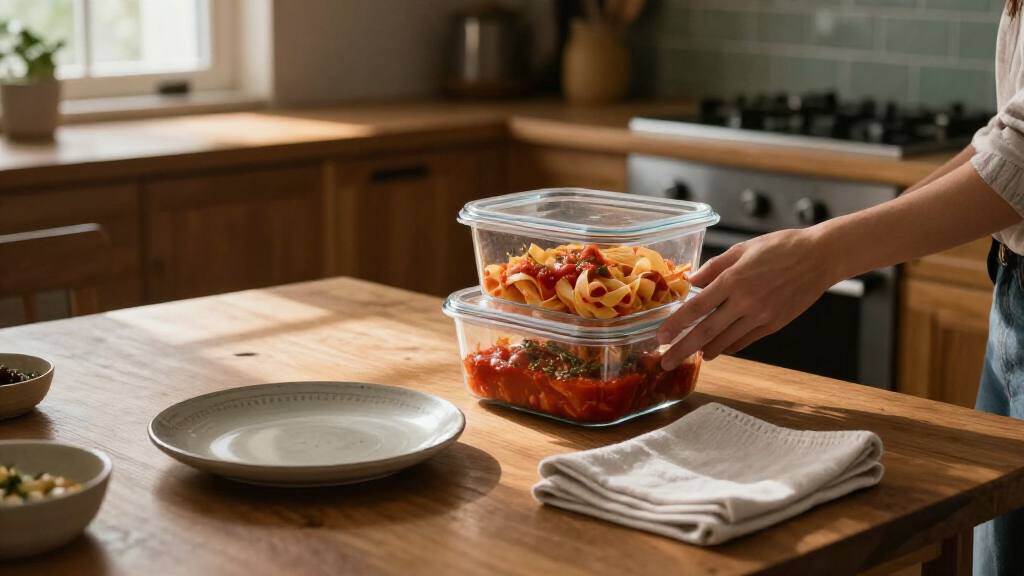

Choosing containers for leftovers comes down to where you store and reheat food, and how often you move it around. Glass containers suit people who want a sturdy, nonporous surface that can go from fridge to microwave or oven when the manufacturer allows it. Plastic containers are lighter, usually less expensive, and easier to pack for work or school, but they can stain, hold odors, and may need replacing sooner.

Get smart everyday buys delivered free with Prime
- Fast, free delivery on millions of items
- Prime Video, Amazon Music and more included
- Member-only deals all year

JSCARES 52-Piece Airtight Food Storage Container Set (26 Containers & 26 Lids)
- ✔ Material: BPA-free plastic
- ✔ Piece count: 52 pieces: 26 containers and 26 lids
- ✔ Container types: 10 rectangular, 10 round, 6 sauce cups

Dealusy 24 oz Meal Prep Containers with Lids, 50 Pack (100 Pieces)
- ✔ Material: Plastic, BPA-free
- ✔ Capacity: 24 fluid ounces each
- ✔ Pack quantity: 50 containers and 50 lids

PROMOZE 50-Pack Reusable Meal Prep Containers, 28 oz, One Compartment
- ✔ Material: BPA-free, food-grade polypropylene
- ✔ Pack size: 50 containers with lids
- ✔ Capacity: 28 oz each
The biggest tradeoff is everyday convenience versus long-term durability and reheating confidence. Glass is the stronger choice for home kitchens where leftovers are reheated often; plastic makes more sense when low weight, portability, and upfront cost matter more. The right choice also depends on the specific product: lids, temperature limits, and care instructions vary, so check those before buying.
At a Glance
| Criteria | Glass food storage containers | Plastic food storage containers | Winner |
|---|---|---|---|
| Reheating | Often microwave-safe; some glass bodies are oven-safe, subject to product instructions | Microwave use depends on the product; many plastic containers are not oven-safe | A |
| Weight and portability | Heavy; less convenient to carry in a lunch bag | Lightweight and easy to transport | B |
| Stains and odors | Nonporous surface resists most staining and lingering odors | Can absorb odors or stain from foods such as tomato sauce | A |
| Durability | Can last for years with careful handling, but may chip or break if dropped | Won’t shatter, but may warp, scratch, or become cloudy over time | Depends |
| Upfront cost | Typically costs more, especially for sets with fitted lids | Usually the lower-cost choice | B |
| Storage and visibility | Transparent and easy to see contents; nesting depends on shape and lid design | Often lightweight and stackable; transparency varies by type | Depends |
| Care and handling | Usually dishwasher-safe, but sudden temperature changes can damage some glass | Easy to handle; heat limits and dishwasher guidance vary by product | B |
JSCARES 52-Piece Airtight Food Storage Container Set (26 Containers & 26 Lids)
When yesterday’s dinner includes a little sauce, a few sides, and a larger main portion, one container size rarely fits everything. JSCARES is the most flexible set in this lineup: its 26 containers include rectangular and round shapes plus six sauce cups, with capacities from 1 ounce to 50.7 ounces. That variety makes it easier to save small additions without giving them a full-size container, while larger pieces can handle a substantial leftover portion.The lids use silicone seals and locking clips, giving this set the clearest stated sealing design of the three. That is a practical distinction over PROMOZE’s leak-resistant lids, especially for liquid-rich leftovers or packing food for transport. Dealusy’s lids are also described as airtight and leakproof, but its 24-ounce uniform format cannot match JSCARES for small sauces or unusually large portions. The containers stack and nest, which helps when storing the set itself as well as loaded containers.There are limits: these are plastic containers, so they may stain or wear more readily than glass, and the lids must come off before microwaving. We’d choose JSCARES when assortment and containment matter more than uniformity. If we mostly portion the same lunch or dinner, Dealusy’s repeated 24-ounce size is simpler; if we want a larger, consistent one-compartment portion, PROMOZE offers more capacity per container.
Pros:
- 26 containers cover a wide capacity range from 1 ounce to 50.7 ounces.
- Silicone seals and locking clips provide a clearly specified closure design.
- Round, rectangular, and sauce-cup formats suit different kinds of leftovers.
- Containers are described as stackable and nestable for storage.
Cons:
- Lids must be removed before microwaving.
- Plastic may stain or be less durable than glass.
Best for: Households that save varied leftovers, including sauces and sides, and want a broad range of container sizes with locking lids.
Not ideal for: Anyone who prefers glass, wants to microwave food with the lid on, or mainly needs many identical portions.
Bottom line: For the widest range of leftovers and the most fully specified seal, JSCARES is the strongest all-purpose pick in this comparison.
“For the widest range of leftovers and the most fully specified seal, JSCARES is the strongest all-purpose pick in this comparison.”
Dealusy 24 oz Meal Prep Containers with Lids, 50 Pack (100 Pieces)
For households that tend to save leftovers in meal-sized portions, Dealusy keeps the format simple: all 50 containers hold 24 ounces and share the same square footprint. That consistency makes portioning and stacking more predictable than the mixed sizes in JSCARES. It also gives this set a clear role for repeated lunches, batch cooking, or dividing a large recipe into similar servings.The snap lids are described as airtight and leakproof, which puts Dealusy closer to JSCARES than PROMOZE on the stated closure language. The supplied details also list microwave and freezer suitability across a stated range of -4°F to 248°F. For leftovers that move between freezer storage and reheating, that range is useful guidance; the containers remain plastic, so we should still follow the maker’s care instructions and use the top rack or hand wash them.What Dealusy gives up is the flexibility of an assortment. A 24-ounce container may be too much for a small side or too little for a generous family portion, and it lacks JSCARES’ sauce cups. PROMOZE offers a larger 28-ounce capacity if we want more room per container, but Dealusy’s standardized size is easier to plan around when portions are similar. Choose this set for repetition and stackable meal portions; skip it if leftovers vary widely in size.
Pros:
- 50 matching 24-ounce containers make repeated portioning straightforward.
- Snap lids are described as airtight and leakproof.
- Stackable square shape supports orderly refrigerator storage.
- Listed as microwave- and freezer-safe within a stated temperature range.
Cons:
- A single capacity is less useful for very small or unusually large leftovers.
- Cleaning is limited to hand washing or top-rack dishwasher placement.
Best for: Meal preppers and households that regularly divide leftovers into similar individual portions and want a large matching set.
Not ideal for: People who need several container sizes, dedicated sauce cups, or glass storage rather than plastic.
Bottom line: Dealusy is the practical choice when uniform 24-ounce portions matter more than having a container for every leftover size.
“Dealusy is the practical choice when uniform 24-ounce portions matter more than having a container for every leftover size.”
PROMOZE 50-Pack Reusable Meal Prep Containers, 28 oz, One Compartment
PROMOZE gives each container 28 ounces, four ounces more than Dealusy’s 24-ounce format. That extra room can suit a fuller serving or a main dish with a modest side, while the one-compartment layout keeps the container uncomplicated. As with Dealusy, the 50-piece set is built around repeatable portions; its capacity is simply the roomier choice of the two.The containers are made from BPA-free, food-grade polypropylene and are described as microwave-, freezer-, and top-rack dishwasher-safe. Their stackable design helps keep a large set manageable, and the lids are described as leak-resistant. Compared with JSCARES, though, PROMOZE has neither assorted sizes nor the specified silicone seals and locking clips. Compared with Dealusy, it offers more capacity but a less assertive closure description. We would be cautious about carrying very liquid leftovers unless the leak-resistant wording meets our needs.The main limitation is the format: every container has one compartment, so foods cannot be separated inside it. That is fine for soup-free single dishes or leftovers that can be stored together, but less convenient for keeping components apart. Plastic also brings the same potential staining and wear concerns as the other two sets. PROMOZE makes the most sense when we want generous, matching portions; choose JSCARES for variety or Dealusy for a slightly smaller standard serving with lids described as leakproof.
Pros:
- 28-ounce capacity offers more room than Dealusy’s 24-ounce containers.
- 50 matching containers support repeated portioning.
- Microwave-, freezer-, and top-rack dishwasher-safe according to the supplied details.
- Stackable design and reusable polypropylene construction.
Cons:
- Single compartment does not separate different foods.
- Lids are described as leak-resistant, with less sealing detail than JSCARES’ locking clips and silicone seals.
- Plastic can stain or wear compared with glass.
Best for: People who want a large matching set for generous single-compartment portions and routine microwave or freezer storage.
Not ideal for: Anyone who wants separated foods, a range of container sizes, or the more fully specified locking seal offered by JSCARES.
Bottom line: PROMOZE is a sensible fit for larger, uniform leftovers when extra capacity matters more than compartments or an assorted set.
“PROMOZE is a sensible fit for larger, uniform leftovers when extra capacity matters more than compartments or an assorted set.”
As an Amazon Associate we earn from qualifying purchases.
Key Differences
For food that stays at home and goes from refrigerator to microwave, glass has the practical advantage. It handles heat well when the container is rated for the intended use, and its surface is less likely to retain the color or smell of strongly seasoned leftovers. That can make one set useful for storing, serving, and reheating. The tradeoff is weight: a glass container full of food is less pleasant to carry, and a drop can end the container’s useful life.
Plastic works well when portability and purchase price lead the decision. It is easy to pack, handle, and replace, and it will not shatter if knocked off a counter. Those strengths matter for lunches, shared kitchens, or households that need many containers at once. The limitations show up with repeated use: some plastics stain or retain odors, and heat exposure can warp some products. Check the maker’s microwave and dishwasher guidance, and replace containers that become cracked or badly worn.
Neither material wins every kitchen. Glass is often the better value for people who reheat leftovers frequently and keep containers for years. Plastic can be the better value when containers travel often, need to be light, or are more likely to get lost or damaged away from home. For many households, a mix is sensible: glass for home storage and reheating, plastic for packed lunches.
Detailed Comparison
Reheating (Glass food storage containers wins — moderate)
Glass wins by a moderate margin. Many glass containers are microwave-safe, and some can go in the oven if the manufacturer says so. Plastic products vary more, and oven use is generally not suitable. For frequent reheating, glass reduces the need to transfer food to a separate dish. Always follow the container’s temperature instructions, since lids may have different limits from the bases.
Weight and portability (Plastic food storage containers wins — major)
Plastic wins by a major margin. A lightweight container is easier to carry in a backpack, lunch bag, or commute. Glass is noticeably heavier, especially in larger sizes, and requires more care in transit. Choose plastic when the container regularly leaves the kitchen; choose glass when most storage stays at home.
Stains and odors (Glass food storage containers wins — moderate)
Glass wins by a moderate margin. Its nonporous surface is less prone to picking up the color and smell of sauces or spices. Plastic can remain perfectly usable while looking stained or holding an odor after repeated use. If appearance and neutral-smelling containers matter, glass is the easier material to maintain.
Durability (moderate difference)
This depends on the kind of damage you expect. Plastic survives drops better because it does not shatter, so it is a safer bet for busy kitchens, children, or travel. Glass resists warping and surface wear, and can serve for many years if handled carefully. The gap is moderate: choose based on whether accidental drops or long-term wear are more likely.
Upfront cost (Plastic food storage containers wins — moderate)
Plastic wins by a moderate margin. It usually costs less to buy a basic set, making it practical when you need many pieces at once or expect to replace some. Glass asks for a larger initial spend. That extra cost may pay off for frequent home reheating and longer use, but it is harder to justify for containers that often go missing.
Storage and visibility (minor difference)
There is no consistent winner. Clear glass makes it easy to see leftovers at a glance, while many plastic containers are also transparent and lightweight to stack. Shape, lid fit, and whether containers nest matter more than material alone. Compare the dimensions and nesting design if cupboard space is tight.
Care and handling (Plastic food storage containers wins — minor)
Plastic has a slight everyday handling advantage. It is lighter to load into a dishwasher and less likely to break during washing or unloading. Glass is also commonly dishwasher-safe, though some products call for care around thermal shock, such as moving a very hot container onto a cold surface. Follow each product’s care instructions rather than assuming all containers share the same limits.
Glass food storage containers: Pros and Cons
Pros:
- Handles repeated reheating well when rated for microwave or oven use
- Resists most stains and lingering food odors
- Clear sides make stored food easy to identify
- Can remain useful for years with careful handling
Cons:
- Heavier to carry, especially when filled
- Can chip or break if dropped
- Usually costs more upfront
- Temperature changes can damage some products
Plastic food storage containers: Pros and Cons
Pros:
- Lightweight and convenient for lunches and travel
- Usually less expensive to buy
- Won’t shatter when dropped
- Often easy to stack and handle
Cons:
- May stain or retain odors over time
- Some products can warp with heat
- Oven use is generally unsuitable
- May need replacement when scratched, cracked, or worn
Who Should Choose What
Choose Glass food storage containers if:
- You reheat leftovers at home in the same container several times a week.
- You store tomato-based, strongly spiced, or aromatic foods and want fewer lingering stains and smells.
- You prefer to pay more upfront for containers that may serve for years with careful handling.
Choose Plastic food storage containers if:
- You carry leftovers to work, school, or other places and want to keep bag weight down.
- You need an affordable set for a large household or shared kitchen.
- You value resistance to shattering more than resistance to stains or warping.
Skip both if: Neither material fits if you need a container for a use its manufacturer does not approve, such as heating beyond its stated temperature limit. Choose a product rated for your specific storage, microwave, freezer, or oven needs.
Value for Money
Pay more for glass if leftovers are a regular part of your home meals and you expect to reheat them in the container. Its resistance to stains and odors, along with its heat suitability when rated, can make the higher upfront cost worthwhile over years of use. Plastic is better value when you need a lot of containers for a modest budget, or when portability and resistance to breakage matter more than appearance over time.
Compare sets by usable sizes, lid quality, and replacement availability as well as material. A low-priced set that does not fit your portions or has lids that are hard to replace may be poor value. If your needs split between home meals and packed lunches, buying a smaller glass set for home and a few plastic containers for travel can avoid paying for features you rarely use.
Final Verdict
For most people choosing one main set for leftovers at home, glass is the better long-term choice: it handles reheating well when rated for it and is less likely to retain stains and odors. Choose plastic if containers regularly travel, if you need to keep the purchase cost low, or if avoiding breakage matters more than a pristine appearance. The deciding factor is where the food will be used: home reheating favors glass, while carrying meals favors plastic. Pay more for glass only when those home-use advantages will matter week after week.
Frequently Asked Questions
Are glass containers better for reheating leftovers?
Often, yes. Many glass containers are microwave-safe, and some are oven-safe, but ratings differ by product and lids may have lower temperature limits. Check the manufacturer’s instructions before heating.
Do plastic containers make leftovers taste or smell different?
Plastic can absorb odors or stain after repeated contact with strongly flavored foods. That does not happen equally with every product, but glass is generally less prone to lingering smells and color.
Is glass worth the higher price?
It can be if you reheat food in the container often and want a set that resists stains and odors. For lunches on the go or a large low-cost set, plastic may deliver better value.
Which type is safer to carry in a lunch bag?
Plastic is lighter and will not shatter if dropped, so it is usually easier to carry. Use a secure lid and keep any container upright to reduce spills.
Fall Picks

Samsung 32-Inch Movingstyle Essential 4K UHD Smart Monitor with Adjustable Rolling Stand
As an affiliate, we earn on qualifying purchases.