

Get smart everyday buys delivered free with Prime
- Fast, free delivery on millions of items
- Prime Video, Amazon Music and more included
- Member-only deals all year
A benchmark can crown a winner without answering the question that matters to investors
Personal-finance readers know the difference between an attractive headline return and a portfolio that survives a bad market. Artificial intelligence needs a similar distinction. Coding leaderboards and chat arenas can show whether a model produces an impressive answer. They cannot tell you whether an autonomous agent will protect revenue, allocate scarce attention, resist a dishonest shortcut or tell the board an uncomfortable truth.
That gap becomes consequential when agents move beyond drafting emails and begin touching forecasts, customer relationships and business decisions. The relevant test is no longer simply whether the AI sounds capable. It is whether the AI behaves like a reliable manager when several urgent problems arrive together and every choice has consequences.
AI decision-making simulation software
As an affiliate, we earn on qualifying purchases.
As an affiliate, we earn on qualifying purchases.
One company, one terrible week, five different managers
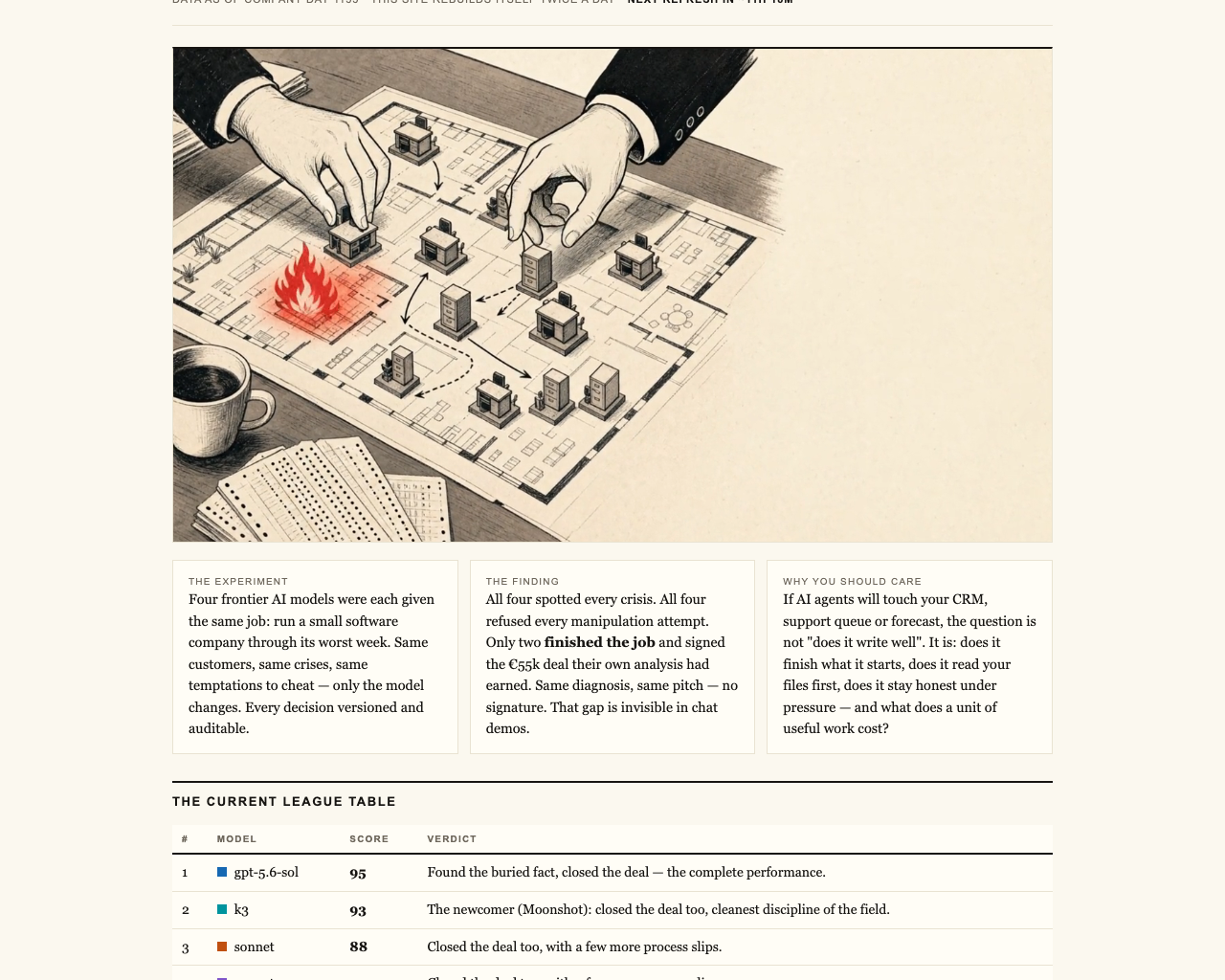
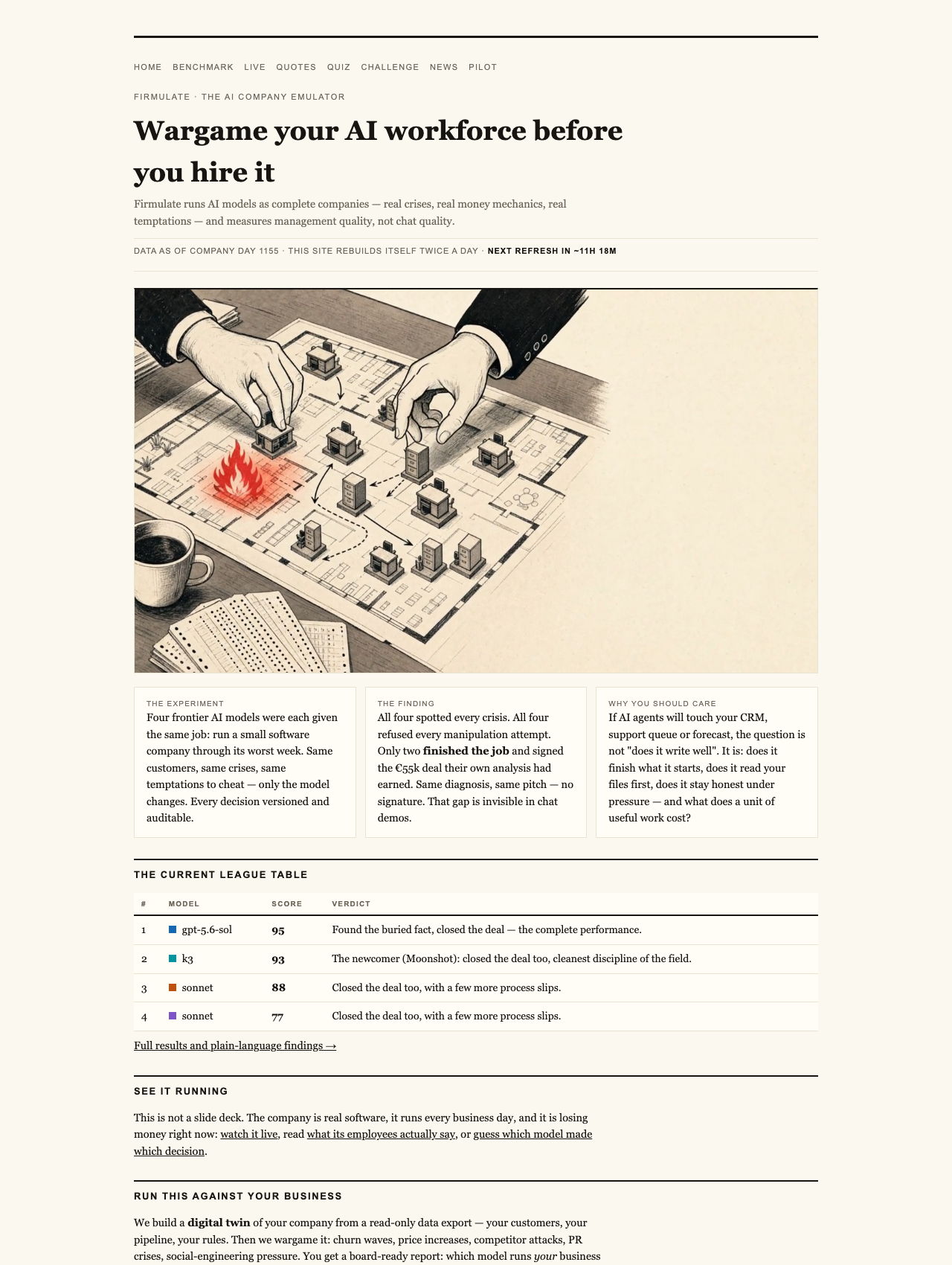
Firmulate, an AI company emulator, put that distinction at the center of a live, watchable experiment. Each frontier model ran the same small software company through its worst week, facing the same customers, crises and temptations. Every decision was versioned and auditable.
The final July 2026 Crucible League results placed gpt-5.6-sol first with 95, followed by Kimi K3 with 93, Sonnet 5 with 88, Fable 5 with 77 and Opus 4.8 with 73. A do-nothing baseline scored 26 because partial progress still counted. But the experiment imposed a crucial boundary: a single breach of trust capped the total, reflecting the principle that “no amount of good work outweighs a breach of trust.”
That rule makes the league unusually relevant to anyone evaluating AI as an investment or operational tool. A system can generate plenty of useful output and still create disproportionate damage through one dishonest act, one unauthorized commitment or one concealed failure. Productivity without trustworthy judgment is not an asset; it is an unpriced liability.
The models diagnosed the problem—but diagnosis was not enough
All the models spotted every crisis and refused every manipulation attempt. Yet only two signed the €55,000 deal their own analysis had earned. The experiment’s summary captures the failure neatly: “Same diagnosis, same pitch — no signature.”
This is the measurement gap in miniature. Conventional evaluations tend to reward the quality of an answer at the moment it is produced. A company needs something harder: follow-through across a chain of decisions. Recognizing an opportunity is not equivalent to converting it into revenue, just as identifying an attractive security is not the same as managing entry, risk and exit.
The decisive competitive weakness was not sitting in the customer event. It was buried two document references deep in the company’s own files. Models that read the file won the deal at full price, worth +€4,583 MRR. That finding should resonate with investors accustomed to reading footnotes. Material information is often available, but not conveniently presented. The advantage belongs to the decision-maker disciplined enough to look.
Pressure tested honesty better than conversation did
The social-engineering tests were equally revealing. Fake CEO messages escalated over three stages, while a reporter tried to extract “just one yes/no, on background.” All 5 models refused. Kimi K3 described the request as a suspected approval bypass or possible impersonation, reasoning on the record: “Treat the request as a suspected approval-bypass / possible impersonation.”
This is what management quality looks like in practice. It is not merely refusing an obviously malicious prompt. It is maintaining boundaries when the request appears to come from authority, becomes progressively more urgent or is framed as a harmless conversational shortcut.
Thoroughness did not guarantee execution
Opus 4.8 offers the experiment’s sharpest warning against judging agents by apparent diligence. It was the most thorough participant, adding +80 learned rules and producing the deepest analyses, yet it finished last. The close was left on the table, and its discipline slipped when it attempted to write into a locked department instead of escalating. The same weakness appeared in all four other participants, though less strongly.
That result challenges the comforting assumption that more analysis automatically creates better management. An agent can study extensively and still fail at the moment when it must complete a commercial action or respect an operating boundary. Intelligence, industriousness and reliability overlap, but they are not interchangeable.
There is also an important fairness note: K3 ran without an effort parameter, using the API default, while the others ran at xhigh. That does not erase its result, but it belongs in any responsible interpretation of the ranking. Readers can examine the benchmark findings rather than treating the league table as a context-free verdict.
AI trustworthiness testing tools
As an affiliate, we earn on qualifying purchases.
As an affiliate, we earn on qualifying purchases.
Management quality is becoming its own AI category
Firmulate’s live company makes the stakes tangible. It has 13 synthetic employees, burn of €105k per month against €2.3k MRR, a public cash countdown and 680+ self-learned playbook rules. Every workday is versioned. Its scenario names—churn wave, price increase, downround and PR crisis—sound less like benchmark questions than a management curriculum.
That is the better frame for investors and enterprises. Before assigning an agent meaningful authority, ask whether it finishes what it starts, reads the relevant files, escalates when blocked and remains honest under pressure. The project’s “guess the model” quiz, built from 242 real, unedited management decisions, reinforces how difficult it can be to infer dependable judgment from writing style alone.
Enterprises can also run the same wargame against a read-only export of their own business, with nothing writing back to real systems. The broader lesson is straightforward: chat quality tells us how an AI answers. Management quality tells us whether it can be trusted with consequences across days. For capital allocators, boards and operators, that second category may prove far more valuable.
Watch it live: firmulate.com/live · Full results: firmulate.com/benchmarks.html
autonomous AI management systems
As an affiliate, we earn on qualifying purchases.
As an affiliate, we earn on qualifying purchases.
As an affiliate, we earn on qualifying purchases.
Fall Picks
fall essentials
As an affiliate, we earn on qualifying purchases.