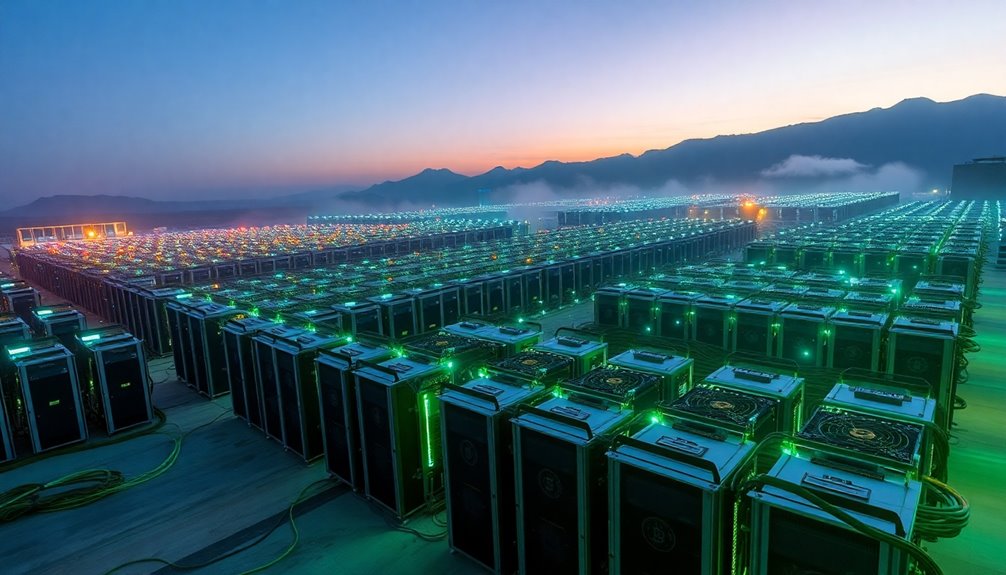

You may have noticed the recent uptick in Bitcoin mining hashrate, which has surged 8% from its lows. This recovery signals a strong determination among miners to adapt despite rising energy costs and declining transaction fees. As the hashrate now sits at 835.9 EH/s, it raises questions about what strategies miners are employing to stay competitive in such a volatile market. What could this mean for the future of Bitcoin mining?

Get smart everyday buys delivered free — and shop member deals
- Fast, free delivery on millions of items
- Access to Prime Big Deal Days deals on October 6–7
- Prime Video, Amazon Music and more included
As Bitcoin's hashrate faces fluctuations, recent data shows a notable rebound in mining activity, despite a previous decline of about 7.6%. Following a dip from a peak of 835.9 EH/s to 771.8 EH/s, the hashrate is now on the rise again, highlighting the resilience of miners in the face of adversity. You might find it interesting that earlier in 2025, the hashrate reached historic highs of over 833 EH/s, indicating a strong underlying network activity that continues to attract miners.
The recent rebound in hashrate suggests that miners are adapting to challenges, even as sentiment has dipped. Factors like increasing energy costs and low transaction fees have made profitability more difficult, leading to concerns among miners. On top of that, competition remains fierce, with larger players consolidating their positions, which could stifle smaller operations.
However, the April 2024 halving spurred significant investments in mining infrastructure, as miners scramble to maintain a competitive edge. Companies like CleanSpark, Bitfarms, and Hive Digital are making strides in boosting their hashrate. CleanSpark recorded an impressive average hashrate of 39.07 EH/s in February 2025, aiming for 50 EH/s by mid-year. Notably, CleanSpark has achieved 100% ownership of its mining portfolio, which highlights its commitment to operational excellence. Bitfarms increased its hashrate by 19% to 15.2 EH/s, while Hive Digital is investing in new sites to reach 25 EH/s by September 2025.
These operational updates illustrate how mining firms aren't just surviving but are actively working to increase capacity and efficiency. Efficiency becomes critical in a landscape marked by rising operational costs. CleanSpark boasts an average fleet efficiency of 17.07 J/Th, while IREN leads North America with an impressive 15 J/Th.
As you can see, these advancements in efficiency help miners offset rising energy expenses and maintain profitability. Yet, the market's volatility can't be ignored. As Bitcoin's price fluctuates, it directly impacts mining profitability and sentiment. The recent decline in hashrate might reflect waning investor confidence, but the current uptick serves as a reminder of the network's security and the ongoing commitment of miners to adapt and thrive.
With technological advancements on the horizon and a renewed focus on energy management, the future of Bitcoin mining could be brighter than it seems, even amidst challenges.
As an affiliate, we earn on qualifying purchases.
As an affiliate, we earn on qualifying purchases.
energy-efficient Bitcoin mining rig
As an affiliate, we earn on qualifying purchases.
As an affiliate, we earn on qualifying purchases.
As an affiliate, we earn on qualifying purchases.
Halloween Picks
halloween
As an affiliate, we earn on qualifying purchases.