
TL;DR
Anthropic’s $965 billion valuation and $65 billion raise mark a turning point: compute access, model training capacity, and enterprise demand are now central to AI’s valuation. Revenue growth is rapid, but the real game is infrastructure dominance.
When a startup hits a $965 billion valuation, most people think about hype, hype, and more hype. But behind the headlines, a different story is unfolding. This isn’t just about a company’s product or technology—it’s about access to massive compute resources. The real game now? How much capacity you can command in the cloud and on chips.
Anthropic’s latest funding round isn’t just a record-breaking check. It’s a declaration: in AI, the biggest value lies in the infrastructure that powers models, not just the models themselves. If you’re curious about what this means for AI’s future—and how the industry is shifting—stick around. We’ll unpack the numbers, the strategy, and why compute is now the currency of AI dominance.
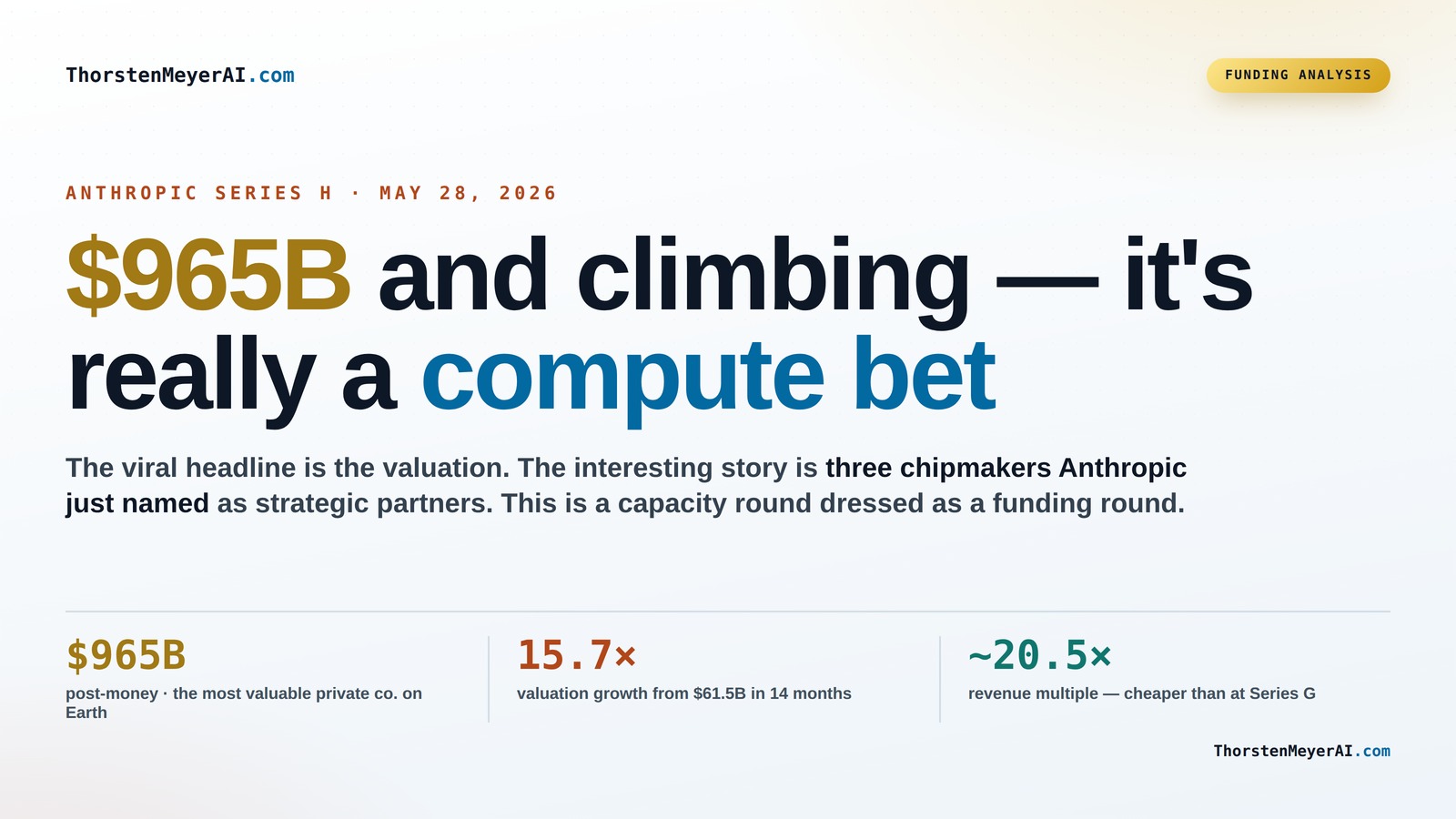
$965B and climbing — it’s really a compute bet
The viral headline is the valuation. The interesting story is in the press release’s middle paragraphs — and in three chipmakers Anthropic just named as strategic partners. This is a capacity round dressed as a funding round.
The numbers nobody can quite parse in sequence
Read together they describe a trajectory with no precedent in enterprise software. Read individually, each looks like a typo.
From $61.5B to $965B in fourteen months
Salesforce took roughly two decades to reach revenue numbers Anthropic just blew past. The sequence below is the part most coverage skips — it’s not the size, it’s the shape.
Anthropic’s valuation ladder · Mar 2025 → May 2026
Five rounds, fourteen months. Bar height is the valuation; the climb itself is the story. Tap any milestone for context.
The multiple actually got cheaper
Bubbles look like multiples expanding while revenue lags. Anthropic’s pattern is the inverse — the valuation tripled, but revenue grew faster, and the multiple compressed.
Revenue-to-valuation multiple · Series G → Series H
Same company, three months apart. The denominator (revenue) is outrunning the numerator (valuation) — exactly the opposite of what a bubble narrative predicts.
10+ gigawatts and three chipmakers
When you name Micron, Samsung & SK hynix alongside your equity backers, you’re saying the binding constraint isn’t demand or model quality — it’s the physical supply of memory chips. The Series H is a capacity round.
Compute commitments backing Anthropic’s capacity bet
$200B+ in announced compute spend across multi-year contracts. The $65B Series H raise has to be read against that bill, not against operating losses.
A genuinely durable bet — or a structural exposure?
Both readings can be true at once. The answer arrives over the next 18–24 months as the gigawatts come online and either fill with paying demand or don’t.
Revenue growth has no precedent in B2B software ($1B → $47B in 17 months). The multiple is compressing, not expanding. Claude is the only frontier model on all 3 major clouds. Enterprise AI spend share went from ~10% to >65% in a year. Compute commitments are tied to specific contracts with capacity dates.
20× revenue is not cheap by any historical software-investing standard. Revenue is reported gross of cloud-reseller pass-throughs, which inflates the top line. Profitability is 2 years out. Amodei’s own warning: a 12-month delay in AI progress “would make him bankrupt” — the compute commitments are a structural exposure to demand persistence.
The valuation race — and the IPO context
Anthropic shipped Opus 4.8 the same morning as Series H — not a coincidence. One week after OpenAI filed confidentially for IPO. The late-2026 frame is set: two frontier AI companies racing to public markets, each pitching durability.
Key Takeaways
- Anthropic’s $965 billion valuation reflects a shift from model quality to infrastructure capacity as the industry’s main driver.
- The $65 billion raise is primarily aimed at expanding compute power, not just funding product development.
- Rapid revenue growth supports the idea that enterprise demand for AI is exploding, making capacity a key competitive advantage.
- Valuations in frontier AI now hinge on access to chips and data centers, not just the technology itself.
- Future AI dominance depends on securing large-scale compute infrastructure—who controls the chips wins.

AI Datacenters: Designing the Infrastructure of the Future
As an affiliate, we earn on qualifying purchases.
As an affiliate, we earn on qualifying purchases.
Why a $965 Billion Valuation is a Sign of the Times
Anthropic’s valuation skyrocketed from $61.5 billion in March 2025 to nearly a trillion dollars today. That’s a 15.7× jump in just over a year. This isn’t just hype; it reflects investor confidence that the company can build, train, and deploy models at an unprecedented scale.
Compared to traditional software companies, this valuation is extraordinary. What’s different? It’s not just about product features but about the underlying infrastructure—chips, data centers, and compute capacity—that fuels the growth.
Real-world example: imagine trying to run a data center with enough chips to train models that are hundreds of times bigger than today’s. That’s what’s behind this valuation surge. It’s a bet that infrastructure, not just code, will determine who owns AI’s future.


Yahboom K230 AI Development Board 1.6GHz High-performance chip/2.4-inch Display/Open Source Robot Maker Python, Supports AI Visual Recognition CanMV Sensor (with Heightened Bracket)
- High-performance AI Chip: 1.6GHz processor with advanced AI capabilities
- Enhanced Computing Power: 13.7x K210 KPU, 8.5x CPU
- Supports Complex AI Tasks: Real-time image and voice recognition
As an affiliate, we earn on qualifying purchases.
As an affiliate, we earn on qualifying purchases.
This is really a compute story — Here’s why
The core reason for the massive round? It’s about compute capacity. Anthropic’s press release emphasizes commitments from chipmakers like Micron, Samsung, and SK hynix, along with over 10 gigawatts of compute capacity. This isn’t just funding for software—it’s a capacity expansion.
Think of it like building a highway network for AI models. The more lanes—chips and data centers—you have, the faster and bigger your models can grow. As demand for Claude skyrockets, so does the need for raw compute power.
Real-world example: during the AI boom of 2026, some companies found their models hitting a wall—not enough chips, not enough data-center capacity. Anthropic’s move signals that securing chips and data-center space is now a strategic battle.


SQL Server 2025 Unveiled: The AI-Ready Enterprise Database with Microsoft Fabric Integration
As an affiliate, we earn on qualifying purchases.
As an affiliate, we earn on qualifying purchases.
Revenue growth: the real indicator or just hype?
Anthropic’s revenue is exploding—passing $30 billion in annualized run-rate, up from $9 billion just six months earlier. That’s a 5.4× increase in roughly 14 weeks. For context, the company expects to hit over $50 billion by the end of June 2026.
This rapid revenue growth supports the idea that demand for models like Claude is real—and huge. But the key question: how much of this valuation is driven by current revenue, and how much by future potential?
Real-world example: imagine a startup’s valuation doubling because investors believe they will soon dominate enterprise AI, even if current revenue doesn’t fully justify it. That’s the new game—future capacity and demand are as important as today’s sales.


AI on Cloud: AI in Business | AI Cloud Case Studies | AI Security Compliance | AI Cloud Training | AI Infrastructure | AI Implementation Guide | AI Innovation Trends | AI Sustainable Development
As an affiliate, we earn on qualifying purchases.
As an affiliate, we earn on qualifying purchases.
How the funds will be used — and what it really means
The $65 billion will fuel three main areas: expanding compute capacity, safety and interpretability research, and scaling products. This shows that Anthropic is betting on a future where AI’s safety and reliability are as critical as raw power.
Think of it as building not just faster cars but safer, smarter ones. The funds aim to push AI safety forward while also making sure models can handle enterprise workloads at scale.
Real-world example: a car manufacturer might spend billions on both speed and safety tech. Similarly, Anthropic invests heavily in making AI both powerful and trustworthy.

How this round reshapes AI’s competitive landscape
Anthropic’s valuation surpasses OpenAI’s, making it the most valuable private AI company. That’s not just a bragging rights story. It signals a shift in power—who controls the largest infrastructure, capacity, and customer demand.
In practical terms, this means fewer startups can compete on raw compute and infrastructure, which are now central to AI’s future. The race is no longer just about models; it’s about chips, data centers, and enterprise contracts.
Real-world example: imagine two companies—one with the best model but limited compute, and another with massive compute capacity but slightly less advanced models. The latter might have a stronger market position now.

Can a company scale into a near-trillion-dollar valuation?
It’s a big question. Anthropic is growing fast—revenue, demand, and infrastructure all point upward. But sustaining a trillion-dollar valuation depends on continuous growth in revenue and capacity, plus the ability to turn investments into profits.
Real-world example: just as a startup can grow quickly, it can also hit a wall if demand stalls or costs explode. The key is whether Anthropic can keep scaling its infrastructure faster than competitors.
Think of it like building a skyscraper—each new floor requires more steel, concrete, and labor. If the foundation isn’t solid, the whole thing risks collapsing.

The future of AI chip demand and infrastructure
Anthropic’s move highlights a future where AI infrastructure is the real battleground. As models grow bigger and demand accelerates, the need for specialized chips, data centers, and high-bandwidth networks will skyrocket.
Imagine a world where every enterprise’s AI depends on a handful of providers controlling vast compute resources. The winners will be those who secure the best chips and the most capacity.
Real-world example: the recent surge in AI chip orders from Nvidia and Samsung shows how infrastructure supply chains are becoming strategic assets.
Frequently Asked Questions
Why is Anthropic worth $965 billion?
The valuation reflects expectations that the company will dominate AI infrastructure, training capacity, and enterprise demand, rather than just current revenue. It’s a bet on future compute economics and capacity expansion.What does a ‘Series H’ mean, and why is this round so large?
Series H indicates a late-stage funding round aimed at massive capacity expansion. The size—$65 billion—signals a focus on securing chips, data centers, and compute resources crucial for AI’s future growth.Is the money going to models, chips, or data centers?
Most of the funds are allocated to expanding compute capacity—chips, data centers, and related infrastructure—along with safety research and scaling existing models.How much revenue does Anthropic actually make now?
Recent reports indicate that Anthropic’s run-rate revenue surpasses $30 billion, with some estimates reaching $47 billion in early May 2026, driven by exploding enterprise demand.Why is compute the main story instead of product features?
Because in frontier AI, access to chips and capacity determines who can build and train the biggest models. Infrastructure now sets the pace and value of AI companies.Conclusion
This isn’t just another big funding round. It’s a signal that in the race to dominate AI, infrastructure—chips, data centers, capacity—drives the valuation more than ever before. If you’re betting on the future of AI, look beyond the models. The real power lies in who can build and sustain the biggest, fastest, safest AI backbone.
So, next time someone talks about AI valuation, ask: how much compute do they really control? Because in frontier AI, that’s the new currency—and it’s worth trillions.